
in the simplicity of our nonage
West with the Night, flamingos, ogres, romance novels, and also there are ghosts, just a little bit

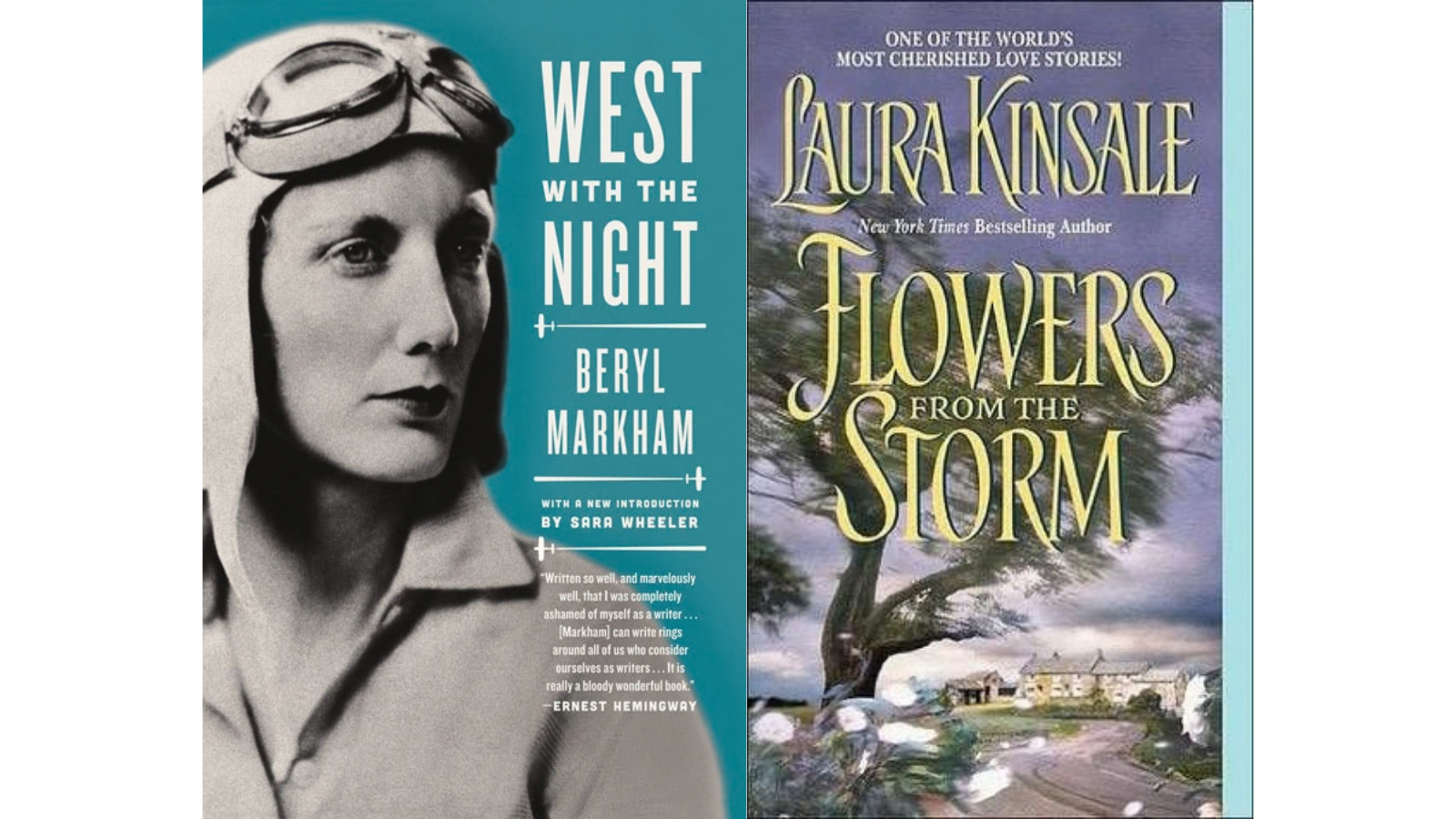
NONAGE, n. This is a word that means “childhood,” or more specifically, the state of not having reached one’s majority or adulthood. It’s quite old, dating back to 1400, but I had never seen it before. I ran across it in Beryl Markham’s memoir West with the Night (1942).
I picked this up after seeing it mentioned in a newsletter from Homeward Books. (The same newsletter where I discovered Dervla Murphy.) After the first sentence, I was so in awe of the prose that I couldn’t put it down. Markham was the first person to fly solo, non-stop across the Atlantic from east to west (the more difficult direction), and West with the Night is about growing up in what is now Kenya in the early 1900s, becoming a racehorse trainer, and then becoming a pilot.
Now, I know what you’re thinking: is this white British woman born in 1902 who grew up in British East Africa very racist? Yeah. Of course. Who are we kidding? But while Markham will make assertions as to which tribes are courageous and which possess intelligence (YIKES), she also loves her neighbors. As a child, her best friend is a Nandi boy named Kibii. They lose touch for a few years and he finds her again when they’re both adults, and he’s gone through a coming-of-age rite and is now called Arab Ruta. (“Arab” is a title and is usually spelled “arap,” for example, Koitalel arap Samoei; that link is one of many Wikipedia entries a person could read to outline that British colonial rule in Kenya was a long string of horrors.)
Arab Ruta tells Markham of what he has lived through in the years they’ve been apart, all the places he’s been and people he’s met, and all the different kinds of wisdom there are in the world. As he finishes his beautiful speech, he asks:
‘Have you in these years, Memsahib, learned more than this?’
Kibii into Arab Ruta — Beru into Memsahib! — this stilted word that ends my youth and reminds me always of its ending —
What a child does not know and does not want to know of race and colour and class, he learns soon enough as he grows to see each man flipped inexorably into some predestined groove like a penny or a sovereign in a banker’s rack. Kibii, the Nandi boy, was my good friend. Arab Ruta, who sits before me, is my good friend, but the handclasp will be shorter, the smile will not be so eager on his lips, and though the path is for a while the same, he will walk behind me now, when once, in the simplicity of our nonage, we walked together.
No, my friend. I have not learned more than this. Nor in all these years have I met many who have learned as much.
There’s such grief in this passage for the lost childhood friendship—and for the freer, more equal, adult friendship that the world won’t allow them. I thought so much about this moment, about how many contemporary pieces of fiction might have written a similar moment with Markham insisting that he not address her as Memsahib, something she clearly dislikes. But that puts her friend in danger—what if they were in public and someone perceived him as disrespecting her? Neither of them has the power to change the whole system. They just have to live within it and try to be friends despite it. And, of course, we don’t know Arab Ruta’s perspective on this scene, or their relationship. We only have Markham’s account. Though he did come back to find her after having lost touch for years, so he must have liked her enough to do that.
Markham is, at times, a difficult person to like. She leaves a lot out of her memoir—a whole child she birthed, for instance—to focus on scouting for herds of elephants by plane so rich white people can hunt them, which is such a clusterfuck of awful that I can’t even begin to unpick it. But I did keep reading her book.
She’s fearless and fascinating and lived a singular life, but there have been a lot of brave people in history, and I’m not casting aside my to-be-read pile for all of them. Only for the ones that can write like Markham. Ernest Hemingway wrote, in a letter to his editor, Maxwell Perkins,
Did you read Beryl Markham’s book, West with the Night? I knew her fairly well in Africa and never would have suspected that she could and would put pen to paper except to write in her flyer’s log book. As it is, she has written so well, and so marvelously well, that I was simply ashamed of myself as a writer. I felt that I was simply a carpenter with words, picking up whatever was furnished on the job and nailing them together and sometimes making an OK pigpen. But this girl, who is to my knowledge very unpleasant and we might even say a high-grade bitch, can write rings around all of us who consider ourselves writers. […] I wish you would get it and read it because it is really a bloody wonderful book.
(The citation for this quotation is complex: I found the full passage in Straight on Till Morning: The Life of Beryl Markham by Mary S. Lovell (Norton, 2011). The “high-grade bitch” part was omitted from the publication of Ernest Hemingway — Selected Letters, ed. Carlos Baker, Granada Publishing, 1981. Lovell adds this footnote:
The phrase ‘and we might even say a high-grade bitch’ appears in the original letter but was omitted from the above work to avoid possible legal problems. This information generously provided by Carlos Baker in correspondence with the author.
Blessed are the authors of nonfiction, for they cite their shit.)
Ernest Hemingway was throwing stones, but he wasn’t wrong about one thing: she could write. Her prose flows so smoothly through complex ideas, and it’s just so sonorous and delicious. And then there’s the pleasure of travel, which it’s easier for me to get from books these days.
Pre-pandemic and pre-kid, back when I used to go places all the time, we went to visit some dear friends who were living in Mexico, in the Yucatán. Our trip was in January, and before we went, my mother, an avid birder, said, “You might see flamingos!” I am fairly certain she said “flamingos” with no qualifiers, and I, a worldly person who has been to the Gulf Coast many times and seen several flamingos, said “Oh, that sounds fun!” without giving it much thought. I planned a day trip to the Celestún biosphere reserve, thinking we might see half a dozen or maybe even ten.
I understand now why my mother said “flamingos” and nothing else. What other word could you possibly use? Certainly the plural was necessary. The feeling I had, when our guide took us out into the mangrove in a little boat, was that my mother should have said “You might see every flamingo in the world.” How could there possibly be any flamingos left anywhere else?
But of course there are. Some of them live in Kenya. Beryl Markham writes of training a thoroughbred filly, strengthening the horse’s weakened legs in the sand near Lake Nakuru:
The shores of its lake are rich in silence, lonely with it, but the monotonous flats of sand and mud that circle the shallow water are relieved of dullness, not by only an occasional bird or a flock of birds or by a hundred birds; as long as the day lasts Nakuru is no lake at all, but a crucible of pink and crimson fire — each of its flames, its million flames, struck from the wings of a flamingo. Ten thousand birds of such exorbitant hue, caught in the scope of an eye, is a site that loses credence in one’s own mind years afterward. But ten thousand flamingos on Lake Nakuru would be a number startling in its insignificance, and a hundred thousand would barely begin the count.
Yeah. It was like that.
While on the topic of East Africa and marvelous writing, I had the good fortune to read Sofia Samatar’s brilliant short story “Ogres of East Africa” (discovered via Alix E. Harrow’s newsletter) recently. I love a short story presented as another kind of document, especially one that’s escaping its boundaries.
And in small-r romance:
Flowers from the Storm (m/f, both cis and het, historical, 1992) by Laura Kinsale. “Look,” I said to myself, “if you’re gonna reread a book instead of making progress on the 34 items marked ‘TBR 2026’ in your reading database, you might as well reread the best book.” So that’s what I did.
It’s hard to know what to say about Flowers. My first attempt, in a sleep-deprived 2022 newsletter, didn’t get it right, and neither will this one. It’s stunning, it’s gripping, it’s witty, it’s sensual, it’s tear-inducing even though I’m a robot who doesn’t cry, it’s plotty, it’s twisty, it’s a lot more about Quakers and mathematics and strokes/aphasia and nineteenth-century English asylums than you might expect, and also there are ghosts, just a little bit. The audiobook narrated by Nicholas Boulton is exquisite. I often paused it—and the laundry I was folding—so I could highlight sentences in my ebook, just to hold onto them a little longer.
When I was reading with my eyes, I highlighted so many passages that I rendered the whole concept of “highlighting” useless. From the fantastic opening sentence “He liked radical politics and had a fondness for chocolate” to this moment when Christian is free from the asylum and has partially recovered from his stroke:
He’d tried to live in the moment, to keep feeling what it felt to be here and now, at liberty, alive. He was not what he’d been. Sometimes the losses caught him like an unexpected slap across the face—small things stinging as hard as the bigger ones: the defiance of his bankers made him angry; the confused wobble of a billiard ball made him want to weep.
Or this moment when Maddy first encounters the baby that Christian’s former mistress delivers to his house:
She heard the fragile whimper of the child and instead of righteous repugnance felt only a surge of love and pain and misery that drowned her—because it was his, and because it belonged to him, and she loved even dishonor and iniquity if it was his.
I thought about quoting the passage where Christian first sees his baby, but I literally can’t look at it without crying, so there’s zero chance I can type it. And of course I thought about quoting a passage about the storm or the flowers, because of the title, but what if you thought those were the only beautiful passages, when really this is a book of nothing but beautiful passages? I needed to quote something less famous, more unexpected. How fucking sexy is this:
The room was silent, except for the slow faint hiss of steam from the coals. In the light of the oil lamp, curves of indigo and cobalt draped down her skirt, rich color against the stark white of her stockings.
This prose makes me feel like I’m going to fall apart. Simultaneous elation and despair: “you can do that with words?” and “no, of course not, only Laura Kinsale can do that.” But thank God she did. Like Christian, I know a miracle when I see one.
That's all for this time. I'll be back in your inbox on October 11.
Word Suitcase is a free newsletter about words and books. If you enjoyed this one, subscribe by email or RSS for the next one. If you know somebody who'd like reading these, please pass it along!
Websites do cost money, so there is a paid subscription option and a tip jar for one-time donations. If you feel moved to support me, I’m very grateful. But please don’t feel obligated. I love having you as a reader either way.