
Having been burned
a day late but not a dollar short: ink, encaustic, manuscripts, romance novels, and Vorkosigans

Here I am in your inbox, a day late, but not, I hope, a dollar short.
INK, n. This word, as in the colored fluid we use for writing, comes from Late Latin encaustum, from Late Greek enkauston, which comes from a Greek root meaning “to burn.” The connection between ink and burning is sort of obscure.
There is a method of painting called “encaustic” where you melt pigmented wax onto a surface, usually wood or canvas. A lot of Romano-Egyptian mummy portraits are done in encaustic, and I always want to look at those, so here’s one:
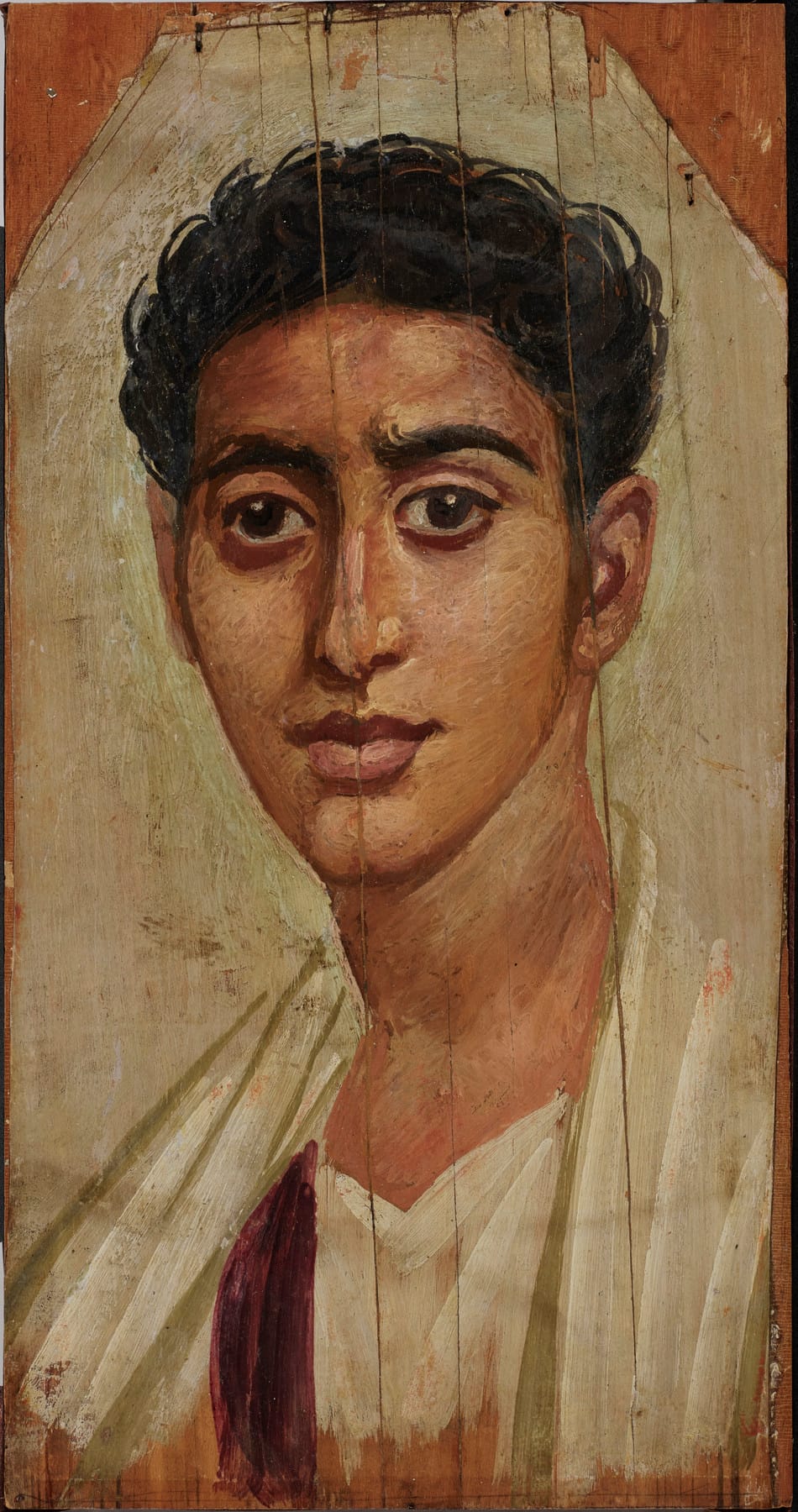
It makes total sense that this method is called “encaustic”: there’s heat involved directly in the process.
As for ink, I don’t know. Per the Online Etymology Dictionary, the Roman emperors had a special purple-red ink called sacrum encaustum that they used for signing documents. This was made from “certain shellfish” and burning was involved in its production. Regular-people ink in Latin was called atramentum, from ater, black.
So at what point did we collectively upgrade our word for ink to the special shellfish stuff?
None of my usual dictionaries ventured into this territory, but I do have one possible answer to offer.
I treated myself to a fancy reproduction of the Voynich manuscript—perhaps, as a reader of this newsletter, you are already aware of the Voynich, but in case you are not (you’re one of today’s Lucky Ten Thousand), it’s my pleasure to tell you that it’s a mysterious unreadable medieval manuscript full of strange illustrations of plants that don’t exist and naked ladies bathing in giant pools with elaborate plumbing. Because nobody can read this manuscript, a lot of study has been devoted to it as a physical object, including its ink. Raymond Clemens, in his introduction to The Voynich Manuscript, writes
…most medieval writing used iron gall inks made from oak galls, some form of iron, and a mild acid, thickened with gum arabic or egg. When first applied, the ink would be light brown in color and watery, but over time a chemical reaction between ink and parchment would cause the ink to darken. Medieval people thought the ink burned its way into the parchment, and the word ink comes from the Latin incaustum, meaning “having been burned.” (xii-xiii)
Clemens is the Curator of Early Books and Manuscripts at the Yale University Beinecke Rare Book & Manuscript Library, so I trust he knows his medieval folklore about ink. It burns its way into the parchment! Of course it does.
Sort of a footnote: If you’re wondering what an oak gall is, it’s an oak tree’s natural defense against insects that puncture its branches and lay eggs inside it. The larvae hatch, secrete an irritant, and the oak tree grows this little round thing full of tannins in an effort to protect itself from the intruder. Tannins turn black if you mix them with iron sulfate (vitriol), and now we’re back to the medieval ink recipe that Clemens describes above.
Sort of a footnote, number two: If you’re wondering why this anonymous medieval manuscript is called “the Voynich manuscript,” boy do I have a story for you! Wilfrid Voynich was a Polish book dealer. He was born in 1864 in the Russian empire, in what is now Lithuania. As a young man, he was a Polish nationalist and a member of the social-revolutionary party Proletariat, for which he was arrested, jailed in Warsaw for a year and a half, and then sentenced to exile in Siberia for five years. Please imagine a movie-soundtrack record scratch here.
In 1890 he managed to escape while working as a hospital pharmacist in Irkutsk, and after five months on the run—including a spell in Mongolia, where he hitched a lift on a caravan to Beijing—he finally managed to reach Hamburg, where he bartered his last remaining possessions, including his waistcoat and glasses, in exchange for a berth on a merchant vessel bound for England. (Arnold Hunt, “Voynich the Buyer,” The Voynich Manuscript 12)
What! People are really out here living lives like this, joining caravans and bartering their glasses to get on ships. Discovering the most famous undeciphered manuscript in the world—when he purchased a lot of books in a secret transaction with the Jesuits in 1912—wasn’t even the most exciting thing that happened to Wilfrid Voynich.
Here’s what I’ve read lately in small-r romance:
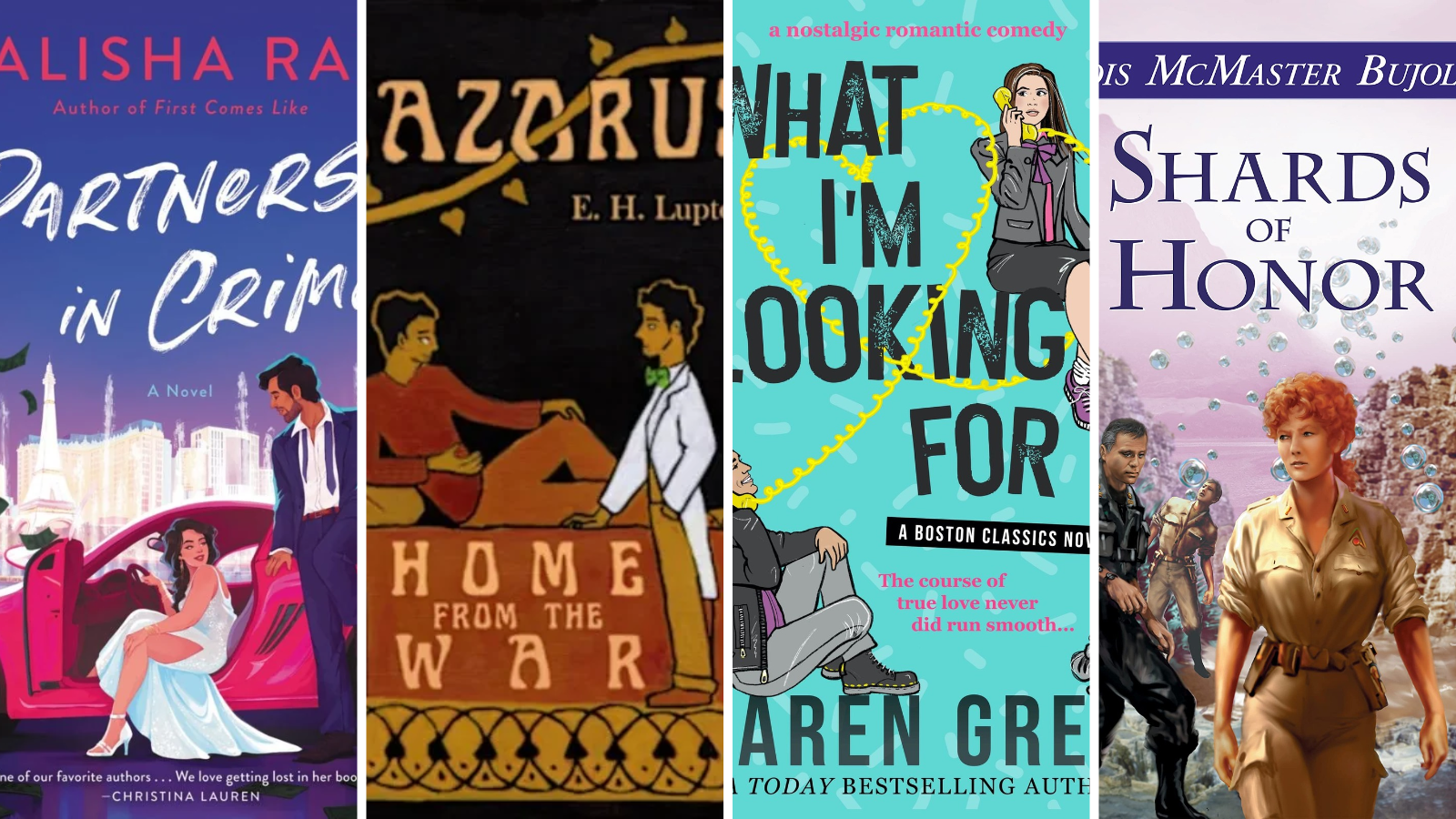
Partners in Crime (m/f, both cis and het, contemporary) by Alisha Rai. Absolutely love to see two people with a complicated romantic history—she broke off their engagement so she wouldn’t have to tell him the truth about her criminal family!—thrown together into a crisis. Mira wants to get married and have a family—a normal family—and be accepted by her Indian community, so she’s been relying on Hema Auntie, a matchmaker with a perfect success rate, to find her a partner. But Mira can’t tell any of her potential husbands the truth about herself, so none of the matches have worked out. In the wake of her beloved aunt Rhea’s death, Mira has to go meet a lawyer for the reading of the will, and unfortunately he’s one of her rejected matches—the one she almost married. Naveen, her lawyer and her ex, isn’t any happier to see her than she is to see him, especially because she seems to have changed her name and lied to him about everything in her life. Immediately after the meeting, they both get kidnapped, and then they end up in Vegas on a desperate, sleepless quest to find the jewels that their kidnappers are certain should be in Mira’s family’s storage unit. All-night diners, car chases, strip clubs, illegal high-stakes poker, infiltrating a fancy charity gala, re-encountering the high school bestie you abandoned years ago and discovering that she’s now a hot lesbian hacker, being extremely mad at and horny for your partner in crime, this book has it all. And Mira is a genius at poker, which is a romance-character trait I have a soft spot for. Tons of fun. Purchased from Kobo.
Lazarus, Home from the War (m/m, both cis and gay?, historical, fantasy) by EH Lupton. This book follows the first three in the series (book one is Dionysus in Wisconsin) and stars Lazarus Lenkov, brother of Ulysses, who has just come home from the Vietnam War and is trying to live like a normal person despite being extremely traumatized. His efforts are complicated by his innate foresight, which is all tangled up with his PTSD, and by weird magical stuff going down in Madison, as is always the case in the series and—I say this as someone who lived in Madison for five years!—and feels entirely plausible for this mid-size Midwestern city of my heart. Laz has the good fortune to have an episode in a tiny market on State St, right in front of a handsome neurologist named Eli, who helps him recover. They take an interest in each other, and then get mixed up in a mystery involving some magic paintings, and it’s a great time. These have lovely prose and such a wonderful sense of place. Indie published; purchased from itch.
What I’m Looking For (m/f, both cis and het, historical) by Karen Grey. This is set in Boston in the 1980s, and if you’re upset that I marked it as historical, I do apologize, but if a character is excited about her new cordless phone, then I simply can’t call the book “contemporary.” I love that the book emphasizes the constraints on how the characters talk to each other: every chapter starts with a a voicemail, and there’s a minor plot point where the heroine is leaving messages on the hero’s answering machine, which he shares with his roommates, so they can hear everything. Kate is an equity analyst who has walled herself off as protection from her male colleagues’ nonstop harassment. She’s excellent at market research, but too nervous to do the schmoozing and public presentations that would get her ahead in her career. Will is an actor at Shakespeare Boston who bartends to pay rent. He meets Kate when she’s out with her colleagues, perceives her discomfort, and makes her a secret mocktail so she can look like she’s drinking with the boys without actually drinking with the boys. Kate and Will have tons of chemistry, but they’re from very different worlds, and he’s got a big chip on his shoulder about how she makes more money than him, which felt like a very real issue—and not only for the 80s. A lot of genre romance treats money as a sort of magic, so it was refreshing to read a realistic approach to both money and the gender roles we ascribe to earning it. I love to open a romance novel and find a critique of capitalism in between all the kisses. This was charming and kept me turning pages. Indie published; read with Kobo Plus.
I have been writing some themed lists of books, which feel like a nice way to revisit book reviews from my archives. So far there’s one on bird bisexuals and a forthcoming one on math geniuses. I’m also working on a big list of all the indie authors whose work I’ve reviewed, but that one is taking a bit longer.
In things that are romance-adjacent, I have started reading Lois McMaster Bujold’s Vorkosigan saga, a long series of science fiction novels. Years ago, before this newsletter existed, I read Shards of Honor (1986), which is an excellent sci-fi romance in which Cordelia Naismith, of Beta Colony (quasi-egalitarian planet full of sexually liberated vegetarian pinko queer scientists), gets entangled with Aral Vorkosigan, of Barrayar (military imperial turbo-patriarchy full of meat-loving isolationist war freaks) in the middle of a different planet where they’re both stranded and in peril. They survive the wilderness together (best trope) and then, from opposite sides of a war, they team up and scheme (second-best trope). I loved it, but was daunted by the length of the series at the time, so I didn’t continue.
Okay, confession: I wrote the above paragraph before re-reading Shards of Honor. Now that I’ve reread the novel, that description doesn’t even begin to capture what’s so enthralling about it. Did I know that my ideal romance novel was two sad, awkward, normal-looking, middle-aged people trying to survive the wilderness and then being caught up in the internecine politics of a space empire? Well, a little bit, sure. But it matters that it’s these people, this prose, this fearlessly complicated moral quagmire of a plot. It’s hard to do the right thing in this world. You can’t ever be sure. But maybe you could be sure about one person, that they were the one for you.
Also, when Cordelia is sitting across the camp fire from Aral, and she thinks about how the shape of power is in his hands? That, to me, is hornier than a thousand sex scenes. Perfection.
And it ends with a devastating little short story about totally different characters and the human cost of war. Lois McMaster Bujold is never, ever gonna let you forget that. Looking back, I think maybe the gut-punch of this ending might be why I didn’t go on, the first time. But this time I did, and I’m so glad I have.
Barrayar (1991) picks up right where Shards of Honor left off, following Cordelia and Aral through the early days of their marriage on Barrayar, where Aral has been appointed regent. Their relationship still plays a role, but it’s much more about pregnancy, bodily autonomy, disability, and parenthood, and it’s really gripping and intense. A person who had, say, survived an ectopic pregnancy via emergency surgery might have to turn off her audiobook in the middle of the chapter where Cordelia has emergency surgery to transfer her fetus to a uterine replicator. (It’s fine. I took a break and switched to print. I don’t know why that helps, but it does.)
Then, separated from the uterine replicator by further emergencies, including a civil war, Cordelia tries to catch up by doomscrolling (Bujold really called that one), and then, exhausted and devastated and aching to know where her kid is, she thinks the core idea of the book:
Anyway, she now realized, the military histories she’d read had left out the most important part; they never told what happened to people’s babies.
No—they were all babies, out there.
Ah, fuck. This hurt so much, but I kind of like it when genre fiction hurts me. There was also plenty of exciting action and heroism, and Barrayar is often quite funny, but you know I kept reading because I needed to find out what happened to Cordelia’s baby, and I cried, because anything about parenthood is an instant KO for me.
As it turns out, Cordelia’s baby is Miles Vorkosigan, and he’s the hero of The Warrior’s Apprentice (1986), which I inhaled immediately after finishing Barrayar. Miles is very visibly disabled on a planet that exterminates disabled people, he’s smarter than you, and at seventeen years old, he finds trouble like he’s rolling up a giant Katamari Damacy ball of it. I would follow him anywhere.
Even into a novella about infanticide, The Mountains of Mourning (1989). Tragic and powerful. I understand its importance to the series, but I gotta be real, I can’t handle reading this one again.
The Vor Game (1990), the next full-length novel, has a scheming lady villain, so obviously I loved it. Basically, it’s about Miles growing up and finding his place in the most chaotic way possible, but the plot is indescribable; four hundred interlocking parts make an absurd Rube Goldberg machine for showing your dad that you’re a man now and can be trusted with galactic diplomacy. All kinds of marbles dropped into chutes and knocked over chains of dominoes and I saw none of it coming. Extremely refreshing after quitting some contemporary romances in which not much happens. They are hoarding all the plot events over in sci-fi.
More on the rest of the Vorkosigan Saga in future newsletters.
I’ll be back in your inbox on November 8.
Word Suitcase is a free newsletter about words and books. If you enjoyed this one, subscribe by email or RSS for the next one. If you know somebody who'd like reading these, please pass it along!
Websites do cost money, so there is a paid subscription option and a tip jar for one-time donations. If you feel moved to support me, I’m very grateful. But please don’t feel obligated. I love having you as a reader either way.