
Metalled
on long difficult journeys—and romance novels

METALLED, adj. This word, as a description of a road, means that it is surfaced with “road metal,” which, per the OED, is broken stone. “Road metal” and “metalled road” both date to the beginning of the nineteenth century. “Paved” is older, dating to 1330, but there seems to be some distinction that I, a speaker of North American English who has never said “metalled road” in my life, am only guessing at. A metalled road is specifically one designed “to sustain vehicular load,” per this Wiki entry on road surface.
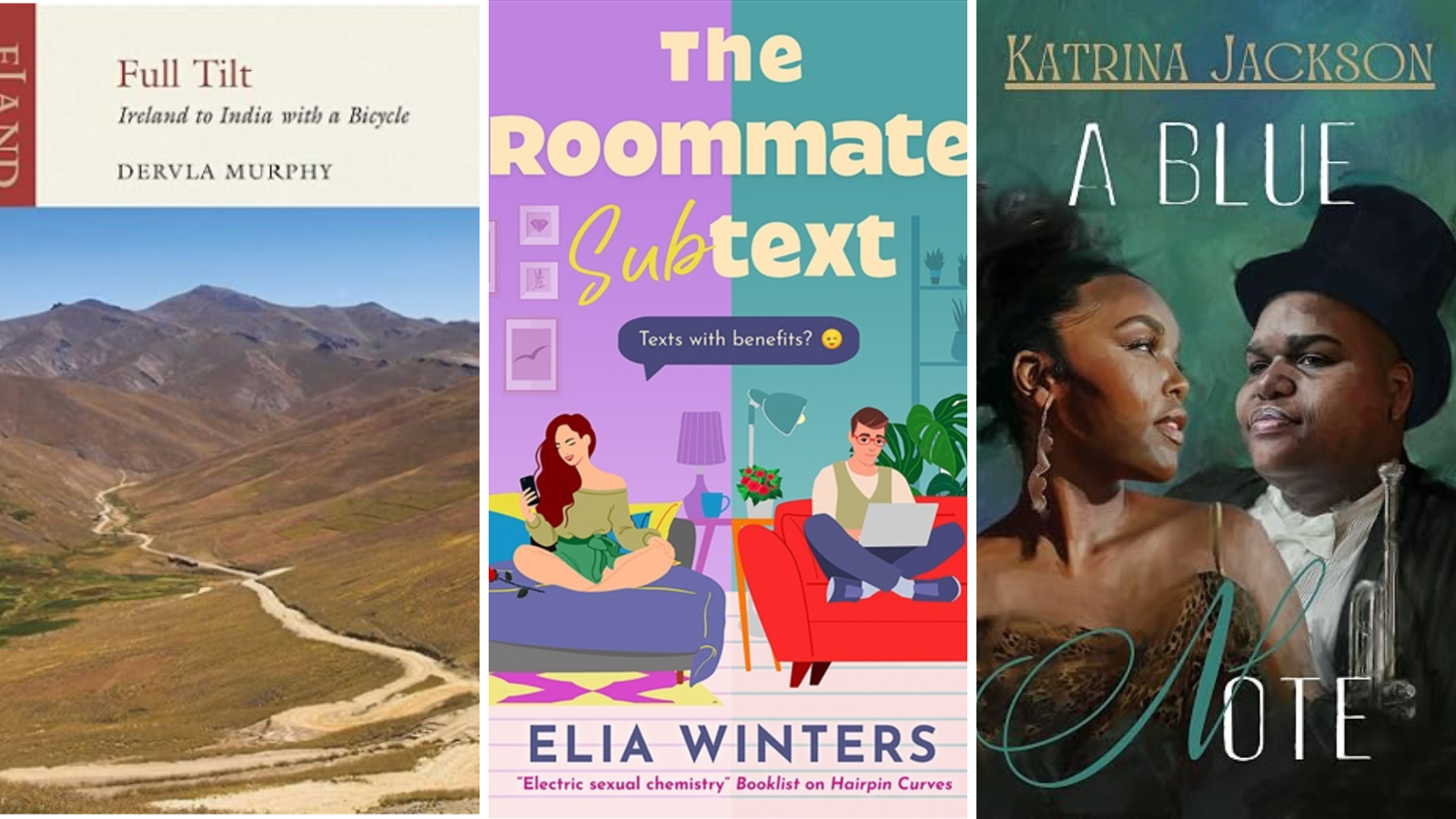
Why am I reading Wiki entries on road surface? Where did I encounter the phrase “metalled road”? Well, it’s because I read Full Tilt: Ireland to India on a Bicycle by Dervla Murphy. This memoir was mentioned in a Homeward Books newsletter, immediately available from my library, and then I couldn’t put it down after I started it. Murphy did indeed ride her bike from Ireland all the way to India in 1963, and this book is her daily journal. After riding over miles of dirt track through Afghanistan, Murphy is very excited to come upon a metalled road. From her description, I guessed “metalled” was paved, but being who I am, I still went running to the dictionary.
Murphy started keeping the journal midway through the trip, so the first chapter is sort of a summary of her ride across Europe. Starting a pattern that continues throughout the rest of the book, she nearly dies several times in chapter one. I was never bored. While I was reading and listening to this, I was also summarizing it to my beloved, a habit he patiently tolerates. After a while, any time I opened my mouth, he’d say, “What’s she up to now?” We took up saying “Dervla!” in response to all her risk-taking, as if fondly scolding a dear friend. I imagine Murphy’s actual friends did the same.
I can’t imagine myself as Murphy, as I would’ve turned around at the first minor inconvenience. I love riding my bike, but I’m strictly a to-the-library-and-back sort of cyclist. You will not catch me riding through ice, or floods, or sand, or extreme heat, or next to a sheer precipice that drops down into a Himalayan gorge, all of which Murphy does. You will certainly not catch me riding anywhere I might have to shoot at a wolf or a would-be rapist, or anywhere an angry crowd might stone me, but Dervla Murphy is a lot braver and tougher than I am, and these things merit only a few paragraphs in her diary, not a full-on sobbing breakdown and a return ticket home.
I joked while reading this that she makes the Tour de France riders look like little babies, since she’s ascending the Himalayas when it’s 112F/44C at lower altitudes, but unfortunately, the Tour de France is getting there. Some cyclists share an enthusiasm for suffering, I suppose. Also, she smokes! I have taken one puff of tobacco in my entire life, to satisfy teenage curiosity, and I can still barely get up a hill, and here is Dervla Murphy summiting enormous mountains with packs of cigarettes in her bike panniers. The twentieth century was fucking nuts, man.
This book will make you love your bed so much. Your functional heating system, your air conditioning, your magnificent indoor plumbing. Murphy loves roughing it, and opines that Westerners would be better people if we were more in tune with nature, and I can’t say she’s wrong—there is absolutely something wrong with us—but also, wow, air conditioning. Lifesaving stuff.
Still, I’m glad Murphy was willing to put herself through all that, because her writing is gorgeous. Here she is, stuffed into a bus-like contraption in Afghanistan with far too many other passengers:
For several minutes, lightning was continuous – not flashes as we know them, but glaring sheets of blue illumination, revealing gaunt peaks on one side and sickening ravines on the other; yet it was all so beautiful and awe-inspiring that one simply forgot to be afraid. The thunder reverberating in the mountains was deafening – peal after peal, the echoes of each being drowned in the crash of the next. With all this came gusts of gale-force wind carrying enormous hailstones which took the skin off my nose where they struck it as I sat next to the window-that-wasn’t.
“One simply forgot to be afraid.” I feel sure I could have managed it, but again, that’s why this is Dervla Murphy’s journey and not mine. She doesn’t require dramatic weather to write beautifully, as many of her more serene walks, rides, and views inspire equally wonderfully passages. Her description of the Buddhas of Bamiyan, two monumental statues carved into cliffs that the Taliban destroyed in 2001, really moved me. I think it would have moved me even if the Buddhas still existed, but since they no longer do, it was poignant. Between the 6th century CE and 2001, a huge number of humans got to see those wonders, and I’m glad Dervla Murphy was one of them.
Murphy is also very funny—dry and witty and resigned to her fate, whether it’s flea bites or death. Her friends back home and many people along the way warn her that she might get killed, undertaking this journey, and so after a breathtaking description of Afghanistan that is sadly too long for me to quote in full, she writes:
This is the part of Afghanistan I was most eager to see, but in my wildest imaginings I never thought any landscape could be so magnificent. If I am murdered en route it will have been well worth while!
Murphy becomes a local celebrity wherever she goes, sometimes because of a newspaper article and sometimes just because she’s such an unusual sight that everyone gossips about her. The people she meets are mostly very welcoming, and I was amazed at how often she was invited to stay in someone’s home. Sometimes that home is a nomad’s tent and sometimes it’s a raja’s palace. She writes:
The farther one travels the more one becomes aware of the extraordinary wealth of generosity and kindness that exists in the world.
As much as I loved this book, and felt I got to know its author, I disagree with her on lots of points. Murphy is very different from Rebecca West, whose memoir of traveling through 1937 Yugoslavia I read part of, but they both have an unfortunate tendency to attribute individual traits (cleverness, courage, dignity, lack thereof, etc.) to whole groups of people. Serbs are this way, Croats are that way. Persians are that way, Afghans are this way, and so on. This tendency is common, but it still makes me clench my jaw every time. And it turns out that if you write “Also, of course, they are very astute businessmen and very unscrupulous money-lenders” about an ethnic group that I am not part of, as a Jew, I will still get angry with you. The very next sentence starts “One of their racial characteristics…” DERVLA. STOP IT. I came all the way up Babusar Pass with you, we’re friends now, you can’t talk about people like this!
She’s very critical of globalization and people losing their culture to wear jeans and drink Coke and drive cars on metalled roads, which I understand. Then again, she also keeps meeting men in Afghanistan and praising how welcoming and kind they are, and then she’ll be like “his seventeen-year-old wife has three children.” She doesn’t praise that part, but she’s also able to shrug it off a lot more easily than I am. Is the subjugation of women really a cultural tradition we have to preserve? Here’s to the pregnant fourteen-year-old girls of Afghanistan who wanted to do something else with their life—bike all the way to Ireland, maybe—and never had a chance.
Anyway, I think it’s good to read books that provide some intellectual friction. I’d much rather read a book like this one, forged in the absolute individuality of its author, with her fearless determination and her strong opinions, than to trade it for something smoother and less offensive. Sometimes the journey’s more memorable if you do it the hard way; Dervla Murphy and I agree on that.
Here are some journeys I’ve taken in small-r romance lately:
The Roommate Subtext (m/f, both cis and het, contemporary, erotic) by Elia Winters. This is a kinky, modern remix of The Scarlet Pimpernel: Blake is a mild-mannered gardener by day and a famous, mysterious Dom by night; Maggie, his roommate, thinks he’s a sweet nerd. She’s sure that Blake’s the type of guy who would be scandalized if he found out that, under the guise of investigative journalism—and an alias, of course—Maggie has been chatting online with a Dom called the Scarlet Pimpernel and exploring kink. (He would be, but not because of the kink.) I’m always a sucker for “they know each other in real life and online, but haven’t realized it,” and this book has so much hot sexting in it—sometimes while Blake and Maggie are separated by a single wall. It’s glorious. You know I love epistolary form. And it’s a real feat to write a book this sexy where the characters don’t touch each other for chapters and chapters, but of course, it is about edging. There’s wonderful dramatic irony in Blake and Maggie not realizing the fullness of their connection, and there’s also nerve-racking plot tension in Maggie being blackmailed by slimy businessman Arnold Chauvel into writing an exposé on his nemesis, the Scarlet Pimpernel. So there’s a real plot and tons of sex. This was so fun that I inhaled it in a single day. Not to bring this review down, but traditional publishers are scared to publish kinky stuff—you know, because of the rising tide of fascist censorship—and a lot of selfpub erotic romance leans “dark,” which isn’t my cup of tea. It sorta feels like we are, as a society, finding it hard to imagine a fictional man who is into BDSM but also… sweet? I mean, I don’t have this problem, and I bet you don’t, either, but publishers don’t want to take a chance on books like that. And that’s bleak. So when I come across a book that’s, like, “just two regular, decent human beings in the regular world, neither of whom has ever been involved in organized crime or murdered anyone, and they fuck a lot, kinkfully,” I say YES PLEASE. Let the regular people fuck! Advance reader copy. Available September 1st. Full disclosure: Elia Winters is my friend, but I wouldn’t say these things if I didn’t mean them. Also, I think you should know that the ebook preorder price for this is only $2.99. If you do Amazon, and you like kinky m/f romance, you should buy this.
A Blue Note (f/f, both cis and lesbian, historical; m/f, both cis and het?, contemporary) by Katrina Jackson. My God, what a gorgeous book. This novel has dual timelines. In 2024, Pauletta Armstrong has just finished her PhD in history, ten months after a suicide attempt, and she’s still fragile. She’s received a postdoctoral fellowship as a researcher at the Society for Black Arts, an archive in New York City, and she has also just received some family history: a box of letters written by her great-great aunt Pauletta “Paule” Campbell, who was a jazz musician in the Harlem Renaissance. The story of Paule’s life is told through scenes of prose fiction, her own letters, occasionally letters from her sister, as well as poems and diary entries from her lover, a poet and painter named Amy Delphine. So we get to read about Paule making a life for herself in NYC while she falls in love with Amy, and we also get to watch Pauletta piece together her story—while she recovers and falls in love with a fellow historian, Dr. Lamine Diallo. Both love stories are really beautiful and moving, but also have such good moments of humor, and because this is a Katrina Jackson book, they’re very sexy. (Paule and Amy, in particular, have a scene on a piano bench that is to die for.) Jackson is a historian when she’s not writing romance, and all the reflections in this book about how to do history—Black history—are such treasures. Pauletta’s great aunt Adelaide, one of this book’s many wonderful supporting characters, tells her she’s preserved all this family history in the form of stories, letters, and artifacts because “The only people who ever cared about remembering us was us, because we loved us.” Pauletta’s mentor and PhD adviser echoes this sentiment when she emphasizes the importance of giving dignity to the people they study, who have often been written out of history, or never written in at all, and Pauletta’s research ends up highlighting “the emotional lives of our ancestors,” as one of her colleagues puts it. A parallel avenue for that kind of work—not history, but the imagining of history—is the historical romance, and this is a beautiful one. When Pauletta figures out that Paule and Amy not only knew each other, but lived and were happy, I got choked up. Their happily ever after is part of hers. What a book. Indie published. Ebook purchased from Amazon because that’s the only place it’s available; I broke my no-Amazon rule for this book and I don’t regret it. If you want this book from a different source, Jackson does sell paperbacks on her site. Her shop is closed right now, but will reopen in a few weeks.
Sort of romance-adjacent: if you’re a sci-fi/fantasy reader, I want you to know about the newsletter Intergalactic Mixtape, which does incredible work compiling a weekly list of book reviews and online discussions of the genre. There’s such a thriving reviewing scene—so many actual blogs!
And in this week’s, I found this series review of Lara Elena Donnelly’s Amberlough Dossier, which is a gorgeously written trilogy that’s kind of like gay James Bond meet Cabaret? Or maybe the better comparison is Le Carré. Anyway, queer spies in a fictional setting that’s sort of like 1930s Berlin. As the review says, it’s complex and melancholy, but there is a love story and some hope at the end. I read these books years ago and still think about them all the time.
Regarding Intergalactic Mixtape and how great it is as a compilation, I think romance’s closest equivalent is SuperWendy/Wendy the Super Librarian highlighting romance reviews under the hashtag #RomBkBlog (on Bluesky and also on Mastodon). Book reviews are work and compiling them is work and I really appreciate both. Social-media-based discussion feels so scattered and impossible to follow; anything that brings together long-form conversations about the genre is a precious resource.
Maybe from time to time, I’ll mention reviews I enjoyed, like this one from Miss Bates Reads Romance on Alexandra Vasti’s Scandal of the Summer, or skygiants on Gaywyck (1980), the first traditionally published gay gothic novel. (That’s not exactly a romance review, but it’s a great read.)
That’s all for this time! I’ll be back in your inbox on August 16.
Also in August, in case you live somewhere near Cambridge, Massachusetts, I’ll be chatting with authors Megan Frampton and Loretta Chase at Lovestruck Books on Wednesday, August 26, at 7PM. It’s a release party for Megan Frampton’s book Demons and Diplomacy—more on this next time! I hope you’ll get yourself a ticket and join us if you can.
Word Suitcase is a free newsletter about words and books. If you enjoyed this one, subscribe by email or RSS for the next one. If you know somebody who'd like reading these, please pass it along!
Websites do cost money, so there is a paid subscription option and a tip jar for one-time donations. If you feel moved to support me, I’m very grateful. But please don’t feel obligated. I love having you as a reader either way.