
Head count
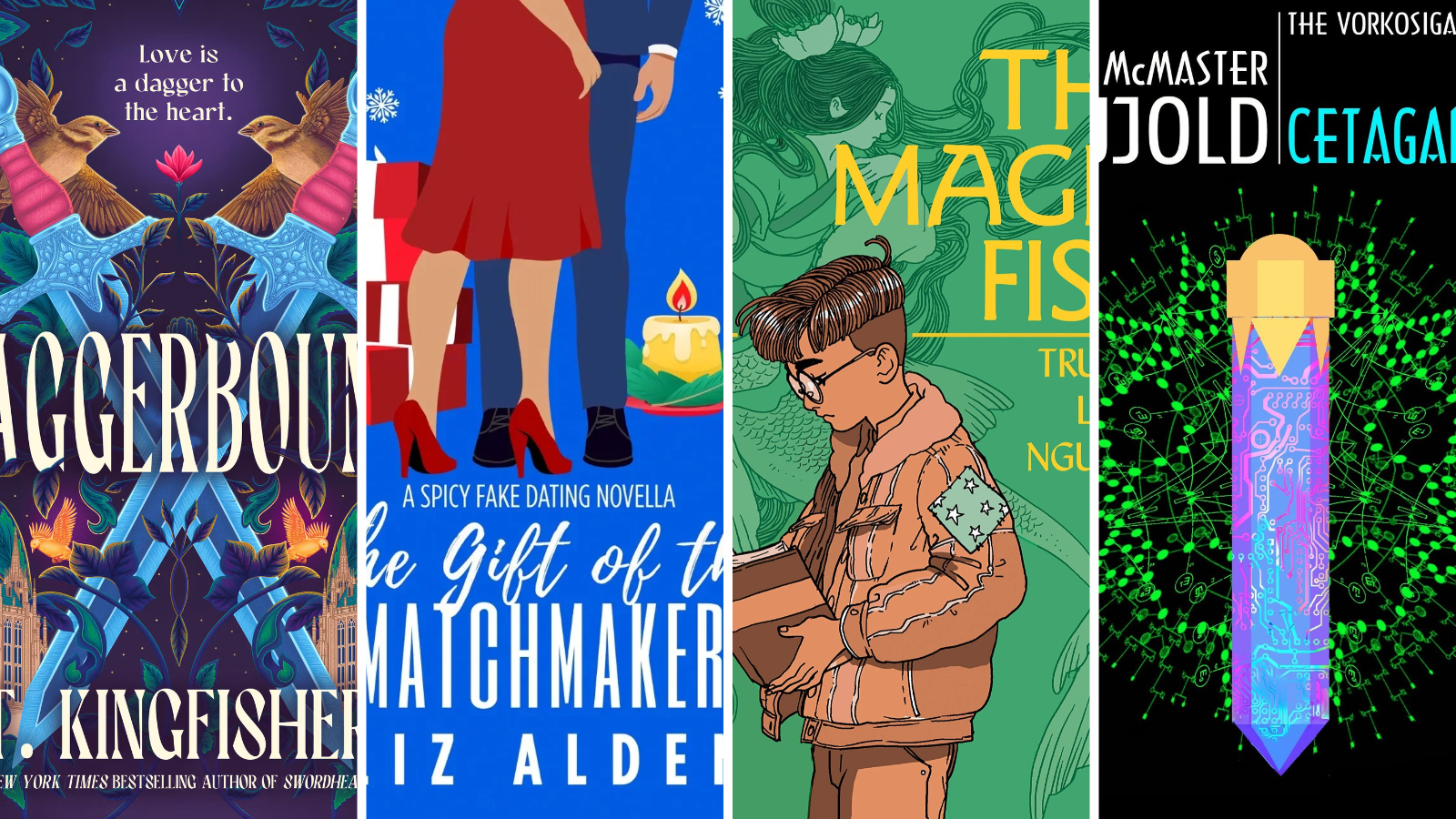
on the word "poll," two romance novels, a graphic novel, and several entries in the Vorkosigan Saga

POLL, n. This word, which in contemporary English now usually means “a survey” or “a place where votes are cast,” is much older than I thought. It’s either inherited from Germanic or borrowed from Dutch “pol” (top, summit), and the OED dates the first usage to 1300, when it used to mean a head, or the part of a head that’s visible in a crowd.
From there, we get senses about counting heads in a crowd, and then counting votes, and then surveying people. Pretty straightforward!
This word has been on my mind for the obvious reason of the US midterm election, and also because I did my first-ever shift as a poll worker on Tuesday. You do have to promise not to say anything political to voters, but our precinct was so busy that I didn’t ever have time to talk to anyone. And I discovered to my delight that once all the voters were gone, the crew of experienced poll workers said whatever they damn well pleased.
Some previous Word Suitcase newsletters on political terms, many of them particular to the US: suffrage, caucus, impeach, filibuster, boycott, left.
Here’s what I’ve read lately in small-r romance.
Daggerbound (m/m, both cis and gay, fantasy) by T. Kingfisher. Sometimes my book reviews get shuffled around, so it’s actually been a couple of months since I read this one, and maybe most of you have already gotten to it. Regardless, it still has to be said: I love T. Kingfisher’s fantasy romances. Characters have adventures, the world is interesting and weird and very solid, the romances feel genuine, they’re just plain fun. I am extraordinarily picky about humor in books, and am usually averse to anything described first and foremost as “funny,” but T. Kingfisher has my number. I think the right word is “witty,” in her case, and at the risk of dissecting frogs, I think a lot of it works because the world is so richly written. I care about these people and where they live. Nothing is flimsy here—not the broad ecological diversity of this magical world with talking badgers and at least three people cursed to live inside swords for hundreds of years, and definitely not the stakes for the characters. We know what to expect—gruff swordwielders who will do the right thing because nobody else is going to, practical older women with niche expertise, beloved animal companions who are not horses, magic that can’t be systematized, strange botany, a temple of problem-solving lawyer priests, and a political world that is complex, fragmented, and unjust, alongside many people who are working very hard to fix that, though it may not be fixable. Anyway, I was delighted to hang out with Edmund (formerly Learned Edmund, of The Clockwork Boys), the Dervish, and their ragtag entourage, and very sad when this book was over. What a pleasure. Purchased from Kobo.
The Gift of the Matchmaker (m/f, both cis and het, contemporary, novella) by Liz Alden. This is a remix of “The Gift of the Magi,” and it opens with a rich recluse on a date with a woman that he is paying to be there, because he’s her sugar daddy, and I was instantly sold on both her extreme practicality (need money, get money) and his whole lonely yearning weirdo deal. He asks her if she’ll be his plus-one to a family wedding in the Berkshires, she says yes in exchange for an enormous fee (get it, girl), and they’re off to spend a week with his horrible family in a winter wonderland. This is sweet, fun, and hot, and it deftly incorporates real-world concerns about money, family, and housing. Eva, the heroine, is desperate to get more money because her father has ALS and needs both care and accessible housing; Lee, trying to counterbalance his family’s legacy of buying up buildings and evicting people from their homes, restores houses and gives them to a land trust to keep them affordable. The matchmaker who initially brings them together, and who continues to oversee their arrangement, is a delightful supporting character. I read this in a single sitting and had a great time. Indie published; Advance Reader Copy. Full disclosure: Liz Alden is my friend and portions of this book were written while I sat across the table at the public library staring at my own manuscript, but I meant everything I said in the review above. Also, just in case any of you all live in western Massachusetts, Liz and I are chatting about romance at the Easthampton Public Library on November 19. (If you don’t live in western Mass, I still recommend clicking the link to see a goofy picture of us.)
And in things that are romance-adjacent, I read Trung Le Nguyen’s graphic novel The Magic Fish, which is simultaneously about a Vietnamese-American teen trying to come out to his refugee parents, European and Vietnamese fairytales, family stories, parenting, growing up, and living between two cultures. They tell each other fairytales and the present story is woven in between. It’s so, so beautiful, and the ending made me weep. A gorgeous book that I acquired secondhand in a gorgeous place.
And for those of you wondering if I’ve made any progress in Lois McMaster Bujold’s sci-fi Vorkosigan Saga, first discussed last week, yes indeed. I’ve done almost nothing but read the Vorkosigan Saga, to the point that when I was working the polls and I asked a voter to spell his name, and he started with V-O-R, I thought “omg he’s Vor.” A Vor lord! In my precinct!
I’ve actually read so many of these by now that I can’t describe them all in the same newsletter unless I want it to be ten thousand words long, which I don’t. So I will save some for later. I’m reading in “internal chronology” order, as opposed to publication order, so these are the next few.
I read Cetaganda (1996), which is a fun murder mystery set on Barrayar’s enemy planet. I love the relationship between Miles and his cousin Ivan, which deepens and gets more complex over the course of the series, and this is the first time we really get to spend a whole book with the two of them, as they get sent to Cetaganda as diplomatic envoys to a state funeral. Miles is 4’9”, disabled in various other ways, and relentlessly active, clever, insubordinate, and ambitious. Ivan is tall and handsome and really just trying to slide by in life; the only attention he wants is from beautiful women. Miles and Ivan grew up together, drive each other nuts, and love each other but will never say so out loud.
Cetaganda made me think a lot about Orientalism—like, is the book engaging in it, showing me this ancient enemy culture that is simultaneously enviably sophisticated, with incredibly beautiful people and art forms, and arcane etiquette, and strict rules separating genders and classes, and murderous internal politics? Or am I bringing the Orientalism, that I see this spacefaring culture with genetic modification and antigrav tech and go, “that makes me think of the Ottoman Empire”? (Or Persia, or China, and so on. I mean, they do call their Celestial Garden “Xanadu.” Though honestly that’s more like evidence that Cetaganda was settled by Westerners. What if the settlers were Westerners trying to enact their vision of Orientalism? Now there’s a concept.)
Arguably, Barrayar also has beautiful people and art forms, and arcane etiquette, and strict rules separating genders and classes, and boy howdy does it ever have murderous internal politics, but it’s so clearly French-Russian-English-German, very purposefully so. And neither Barrayar nor Cetaganda is presented as unchanging. They’re both extraordinarily complicated places.
I don’t think we can ever really get away from real-world history and culture when we write sci-fi and fantasy, no matter how hard we try. And readers, presented with a made-up culture, might reflexively seek associations with real cultures, as I did. As a writer, the best you can do is to think through your artistic choices, which McMaster Bujold does. Nothing is lifted wholesale from history—though a pastiche of different cultures is, of course, also characteristic of Orientalism—but there are tributes here and there. There are also wholly new things. I think one of the best ways you can differentiate your made-up culture is to really focus on its magic or aliens or impossible technologies, things we don’t have in the real world, and that is definitely on display here.
Anyway, Cetaganda is absolutely nonstop adventure and it has sooo many women characters. It’s great. Saying anything else about them would ruin the surprise.
I also read Ethan of Athos (1986), which doesn’t have Miles in it! He’s on Cetaganda solving the aforementioned murder mystery. Ethan of Athos is very forward-thinking, for 1986, in having a queer man as a main character, though it accomplishes this through proposing Athos, a planet populated entirely by men, who use uterine replicators and order the necessity genetic material from other worlds, and only allow babies with XY chromosomes to be born. They never speak of women, and the only romantic relationships are between men. Trans women aren’t accounted for in this worldbuilding, unless you assume, as I did, that it would be so terrifying to come out as a trans woman on virulently misogynist Athos that they all either stay in the closet or run away. (Bleak. But Athos is bleak in a lot of ways.)
That said, the premise “guy who has never seen a woman before and is scared of them” combined with Miles’s fierce galactic mercenary/spy Elli Quinn as the woman—it’s so good. The good guys and the bad guys are all trapped on a space station searching for a very important, very secret lost item. I think maybe this qualifies as a caper. I read it straight through in a single evening. (Now that I think of it, this book is sort of a nice pairing with Daggerbound, which also features a queer guy emerging from a misogynist institution and realizing women aren’t so bad. Though in the case of Daggerbound, this realization has happened years prior to the action.)
Next up were two novellas, “Labyrinth” (1989) and “The Borders of Infinity” (1987). You might think, if you were considering undertaking the Vorkosigan Saga, that the short fiction is supplementary, like an extra credit assignment, but I promise you it is essential. “Labyrinth” is a meditation on bodily difference, featuring Miles, Bel Thorne, a “Betan hermaphrodite” who uses it/its pronouns, and Nicole, a “quaddie” who has two other arms instead of legs. The three of them come across another character who is the result of a genetic experiment and they mount a rescue.
“The Borders of Infinity” is Miles at his most Miles, thrown into a situation where he has nothing but his wits—and using them to perform miracles. It is such a feat, both in terms of what Miles accomplishes and in terms of what Lois McMaster Bujold accomplishes. This story has ramifications for every book that comes after it. Characters will refer to “the events on Dagoola IV,” and you’re gonna wanna know what they’re talking about.
Most of these, I checked out the audio and the print from the library. A couple of times, neither of these options was instantly available and I got impatient and bought an ebook from Kobo.
Bonus link: CanvasRebel, which is an online magazine about people running businesses in the arts, recently interviewed me.
That’s all for this time. I’ll be back in your inbox on November 22.
Word Suitcase is a free newsletter about words and books. If you enjoyed this one, subscribe by email or RSS for the next one. If you know somebody who'd like reading these, please pass it along!
Websites do cost money, so there is a paid subscription option and a tip jar for one-time donations. If you feel moved to support me, I’m very grateful. But please don’t feel obligated. I love having you as a reader either way.