
Donkey pepper
donkeys, herbs, romance novels

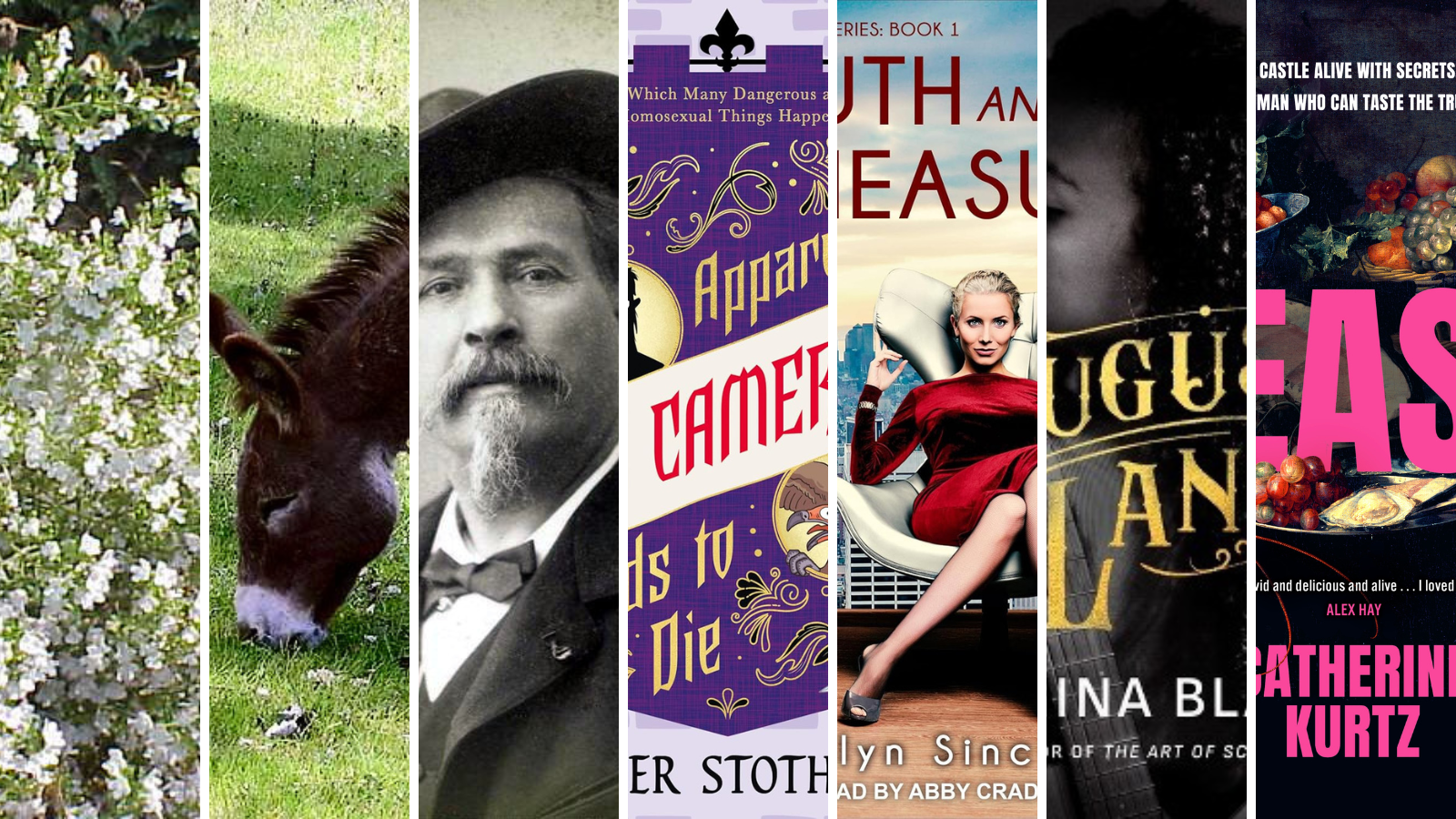
PÈBRE D’ASE, PÈBRE d’AI, n. This is a Provençal phrase, something I’ve never had in the newsletter before. In French it’s “poivre d’âne,” which happens to be the name of a restaurant in Aix-en-Provence where I had dinner with my family seven years ago. My mom tried to jog my memory about this place by saying “it's the restaurant where you mapped out an etymology on the back of a napkin,” but this is not as helpful a memory aid for me as you might think. Anyway, she wanted to know about the restaurant’s name. In English it’s “donkey pepper.” What the hell, you might ask, is donkey pepper? And why is it called that?
Well, the first question is easy, at least. It’s the herb called savory, “sarriette” in French.
As for what savory has to do with donkeys, it’s a real choose-your-own-adventure story out there.
But first, let’s back up: “Provençal” is a language spoken in Provence, the modern-day region in the south of France, and a few neighboring areas. Provence is part of a larger region/culture called Occitania that spans the south of France, Monaco, the Val d’Aran in Spain, and in Italy’s Occitan Valleys. There’s a language called Occitan and many related languages (Provençal, Auvergnat, Limousin, Aranese, etc). “Provençal” was once an umbrella term for these languages. People still sometimes use Occitan and Provençal interchangeably, which you’ll see in the citations below. These days, linguists acknowledge that all these languages are different, and Provençal is specific to Provence.
France used to have tons of thriving regional Romance (and a few non-Romance!) languages, despite a long history of the state trying to crush them, whether by conquest or official dictionaries or public education. Sometimes the state was, unfortunately, pretty good at forcing people to abandon their language. Provençal still exists, though, and per Wikipedia it had around 350,000 speakers in 1990. It does merit an entry in UNESCO’s Atlas of the world’s languages in danger. On the other hand, considering what it’s survived so far, it’s impressive that Provençal is still here. Take that, Abbé Grégoire!
One other thing you need to know about Provence, for purposes of this newsletter, is that there is a famous wind there called le Mistral.
Once you know that, it seems kind of like fate—nominative determinism—that the nineteenth-century Occitan writer and lexicographer who championed Provençal and wrote a dictionary, Lou Trésor dou Félibrige ou Dictionnaire provençal-français, was named Frédéric Mistral. (When I first read about him in grad school, I thought for sure he was using a pen name. It’s like if you were gonna write about Louisiana and you named yourself Fred Bayou, or if you were gonna write about Yellowstone and you named yourself Fred Geyser. But he didn’t name himself anything! Mistral was his real family name. Or, in some Provençal spellings, he was Frederi Mistrau.)
So obviously I wanted to see what our friend Frederi Mistrau, hero of Provençal, had to say about donkey pepper. Here’s my translation of the entry:
PEBRE-D’ASE, PEBRE D’AI (m.), (donkey pepper), n. m. Mountain savory, satureja montana (Lin.), plant, see also sadrèio.
Froumaye au pèbre d’ase, cheese flavored with savory.
And then Mistral quotes a couple of lines of text! It’s in Provençal, of course, which I don’t speak. But I have a searchable version of Lou Tresor dóu Felibrige, among others, a conjugation chart, and a lot of help from some generous, knowledgeable people on Bluesky. Here we go:
Testilis touto à flo dins lou mourtié n’embrigo
Juvert, mentastre, aiet, rouqueto e pebre-d’ai.
J.-F. Roux
Thestylis crushes pell-mell in the mortar
Parsley, white horehound, garlic, arugula and donkey pepper.
J.-F. Roux
That took me such a long time, and I couldn’t do it alone. The person who cracked the case on “Testilis” is translator Hamid Ouyachi, whose forthcoming work translated from Moroccan Tamazight looks very cool. We were brought into contact by Celtiber. (Both these people have special characters in their names that Ghost Pro can't display, apologies.) Asking this question introduced me to a number of people who are passionate about language and were excited to decipher a couple of random lines of Provençal with me. Sometimes the internet is good!
Thestylis is the name of a handmaiden to a woman who casts a spell on her lover in Idyll 2 by ancient Greek poet Theocritus. I think it’s likely that Thestylis is doing some spellwork in the J.-F. Roux poem above. The listed plants are all edible herbs, some of which have uses in folk medicine. There’s a note on Mistral’s entry for “juvert” (parsley) that it can also mean “fool(ish)” or “a woman’s mons pubis.” Saucy!
At long last, let us return to our sheep, or donkeys, as the case may be. Why is donkey pepper called that? The website called La Langue française offers this explanation (my translation):
From the Occitan pèbre d’ase, donkey pepper, because donkeys seem to take great pleasure in eating this plant.
So donkeys love eating donkey pepper. Simple. Got it. But then French Wikipédia gives a different explanation (also my translation):
Savory is sometimes called pèbre d’ai or pèbre d’ase (which means “donkey pepper” in Provençal, because of its supposed aphrodisiac virtues, since local custom has it that donkeys are “well endowed”)
So there we have it. Perhaps donkeys love eating donkey pepper for its aphrodisiac properties, too. Perhaps all that savory is how they got so well endowed.
Speaking of aphrodisiac properties, here's what I've read lately in small-r romance:
Apparently, Sir Cameron Needs to Die (queer, speculative, pleasingly uncategorizable) by Greer Stothers. People are gonna tell you to read this book because it’s funny. They won’t be wrong. A prophecy says that the evil sorcerer can at last be defeated if the beautiful cowardly knight Sir Cameron dies, so everyone starts trying to kill him—except the evil sorcerer, who now has reason to keep him alive. They end up in his evil lair together. Good premise, right? Lots of comedic potential. It’s great. But that’s not why you should read this. You should read this book because it is so profoundly unexpected. You will open it and think you understand what it is: fantasy parody, gay romance. And it will be those things! It will also, however, explode and reassemble itself. This book never met a genre or a gender it didn’t want to deconstruct. It is full of both gore and genuine feeling. Library loan.
Truth and Measure (f/f, both cis and bi, contemporary) by Roslyn Sinclair. This book is The Devil Wears Prada, but the plucky young assistant actually gets together with her cold and imperious boss, as it should’ve been. The boss character does discover, upon getting divorced at 42, that she has an improbable accidental pregnancy, which used to be a thing I could not handle reading, but apparently imagining the Anne Hathaway/Meryl Streep combo can carry me through. This is very slow burn, but it’s deliciously tense. Small press published; library ebook.
August Lane (m/f, both cis and het, contemporary) by Regina Black. God, what a stunning book. I started reading this back in March and put it down because some of the child abuse in the flashbacks is just gutting. But I love Regina Black’s writing, and I couldn’t stop thinking about this book, so I went back, more prepared this time for the heavy subject matter. I’m so glad I did; this book is a masterpiece.
August and Luke grew up in the same small town in Arkansas. She’s the daughter of a Black country star, Jojo Lane, who was always touring. Raised by her strict grandmother, August is a social outcast as a teenager. Luke grew up on a farm with an abusive single mother suffering from addiction, which he hides. He’s well-liked in town because he’s good at football, though this is contingent on him staying in the white quarterback’s good favor. As high school students, Luke and August orbit each other, fascinated but often kept apart by circumstance. He pays her for songwriting lessons. Together, they write a song, with August providing the lyrics and Luke setting them to music. He gets out of town by winning a reality TV show called Country Star. Their song becomes a huge hit—but August never gets credit. Years later, after Luke’s alcoholism has blown up his music career, he comes back to their hometown, five years sober but flat broke, to play a concert with August’s mother, who is being inducted into the Hall of Fame. August is still there, having blown up her own life in other ways, and there is a deep well of bad feeling between them. Still, they’re drawn to each other.
The complexity in their relationship is augmented by the complexity in every relationship in their families and community. Even Luke’s abusive mother, the most unlikeable character in the book, has her own struggles and humanity, which is not to say the book excuses what she does. Just that it’s a marvel how Regina Black weaves together all the threads here. Everyone is shaped by their environment—racism, sexism, poverty, grief, religion, the rural town, the lack of healthcare, the prison system, the absence of bodily autonomy and justice—but we can also see which characters choose to break cycles of abuse, like Luke, and like August’s uncle Silas, who gets out of prison and gets into recovery for his heroin addiction. And like August, who understands that her own mother should have had access to abortion, and who chooses to provide that access when another character needs it. (I think this might be the most pro-abortion romance I’ve ever read, and I mean that as the highest of praise.)
The world is a hard place to live, but some things make it easier—friendship, shelter, food, love, sex, and music. August Lane has a deep love for country music, right alongside the genre’s history of hostility to Black musicians and fans—and what genre could be better than country, for loving something that doesn’t always love you back? Some of the best parts of the book are descriptions of August and Luke making music, separately and together, and the interstitial sections where Jojo Lane gives an interview on a podcast. I love mixed media in a novel, and the podcast is great to read with your eyes and even more fun on the audiobook.
But most of all, this book is a sweeping romance. It believes so strongly in the possibility of righting wrongs, of healing, of falling in love and seizing happiness while we can. There is no promise that life won’t hurt—just that when it does, there will still be music. Library loan in print, ebook, and audio, lol.
And in things that are neither Romance nor romance, I read Feast by Catherine Kurtz. It’s a historical novel set in late 19th-century England and France, starring Minha, the daughter of an Indian sailor and a white Englishwoman. Minha has a supernatural sense of smell and taste—she can eat a plum and identify the orchard it came from—and she ends up in France as a poison taster in a duc’s household. This sounded intriguing, plus there’s a 17th-century Dutch still life on the cover, so I picked it up. Kurtz is also a food writer, and it shows: every food description is sumptuous.
When she came to unpeel her first chestnut, she was ready. Sated with the scent of them. But the true magic happened in her mouth. She lost sight of the world around her. The seller’s banter faded to a muffled back-note. Her whole being lived within the gradual and vivid unfolding of flavor. Gentle, powerfully comforting, the chestnuts spoke of freshly baked rolls and hot potatoes, of the burned edges of a Christmas cake, of sweet apple, and of the high old trees in Kent where they were harvested. They had one flavor, and a hundred, or more. And they shut out the cold, the hunger that she often lived with, and the panic of her solitude, on the riverbank, in the big harsh city, in the one room she shared with her mother.
The prose is beautiful throughout, and I loved it. However, the bulk of the novel is Minha suffering deprivation, humiliation, abandonment, and betrayal, and I found that really difficult to read. It’s very affecting! People are so viciously racist and cruel to her, and she ends up trapped in such a grim situation. At about the one-third mark, I thought, “Is anything good going to happen?” And then it seemed like maybe something good might happen, so I kept going. And then she got raped on page at 57%, and I had to skim to the end because I was so distraught. Minha is brave and kind and hardworking and I wanted her to experience some justice and sweetness and comfort. And friendship! She does, sort of, but it’s so hard-fought, and most of the book is her suffering, that I can’t say I really enjoyed my reading.
This book is kind of an enlightening contrast with August Lane, above, which contains a lot of unvarnished ugliness and suffering, but which is a romance, and thus comes wrapped in the promise that our main characters are gonna make it out okay. (Comes wrapped in, and amply fulfills, I should say.) Perhaps I am a reader of simple, unsophisticated tastes, but I prefer that. You might have a higher tolerance for fictional pain than I do, and if so, maybe you’d care to sample Feast. Advance reader copy. This book comes out on June 9.
We are two days from the seventh (!) anniversary of Word Suitcase, on which occasion I like to revisit some of what I’ve written in the last twelve months. (Previously: Year I, Year II, Year III, Year IV, Year V, Year VI.)
The most fun I had writing was discovering a secret anagram in Judy Cuevas. Naturally I did not stop there, and went on to write about condoms and deliquescence in Judy Cuevas, too. If that latter newsletter can move the needle on getting her out-of-print books back into publication, I’ll die happy.
I loved reading, reviewing, and chatting about TJ Alexander’s latest book A Lady for All Seasons at Lovestruck Books, which was such a joy. If you are reading this and wondering if I would chat with you about your book, or do some other kind of bookish event online or in person at your bookstore or library, please reach out.
The most fun word of the last twelve months, I think, was boustrophedon.
I'll be back in your inbox on June 21.
Word Suitcase is a free newsletter about words and books. If you enjoyed this one, subscribe by email or RSS for the next one. If you know somebody who'd like reading these, please pass it along!
Websites do cost money, so there is a paid subscription option and a tip jar for one-time donations. If you feel moved to support me, I’m very grateful. But please don’t feel obligated. I love having you as a reader either way.