
Having a ball
balls, blushing, nonbinary ladybugs, and my kid's first romance novel

BALL, n. I mean this noun in the sense of “a party with dancing,” not “round thing you throw in a game.” They have different roots. This word came up because my kid and I read a book with characters attending a ball. He asked what it was, and then very charmingly called it “the ball party” for brief but wonderful time. (To this I said, "That's something different, I think.")
English gets “ball” as in a social event with dancing from French bal, meaning the same thing, and those of you who speak Spanish/Portuguese or Italian might already have made the connection with bailar or ballare, verbs meaning “to dance.” Old French had baler/baller, but at some point it was supplanted by danser, and the Trésor de la langue française has a spicy little note, which I have translated:
This term, which is used in contrast to ballare to mean elegant and rather solemn dances,
Their rowdy and vulgar ballare, our elegant and solemn danser!
Anyway, the note continues:
[danser] belongs to the langue d’oïl [FD: continuum of Romance languages historically spoken in northern France], and is thus probably Germanic in origin, though it is not possible to identify an etymon with certainty.
You know I love an obscure etymon. I also love books with parties and dancing in them, whether rowdy and vulgar or elegant and solemn.
And now that we’ve talked about capital-R Romance, let’s talk about small-r romance:
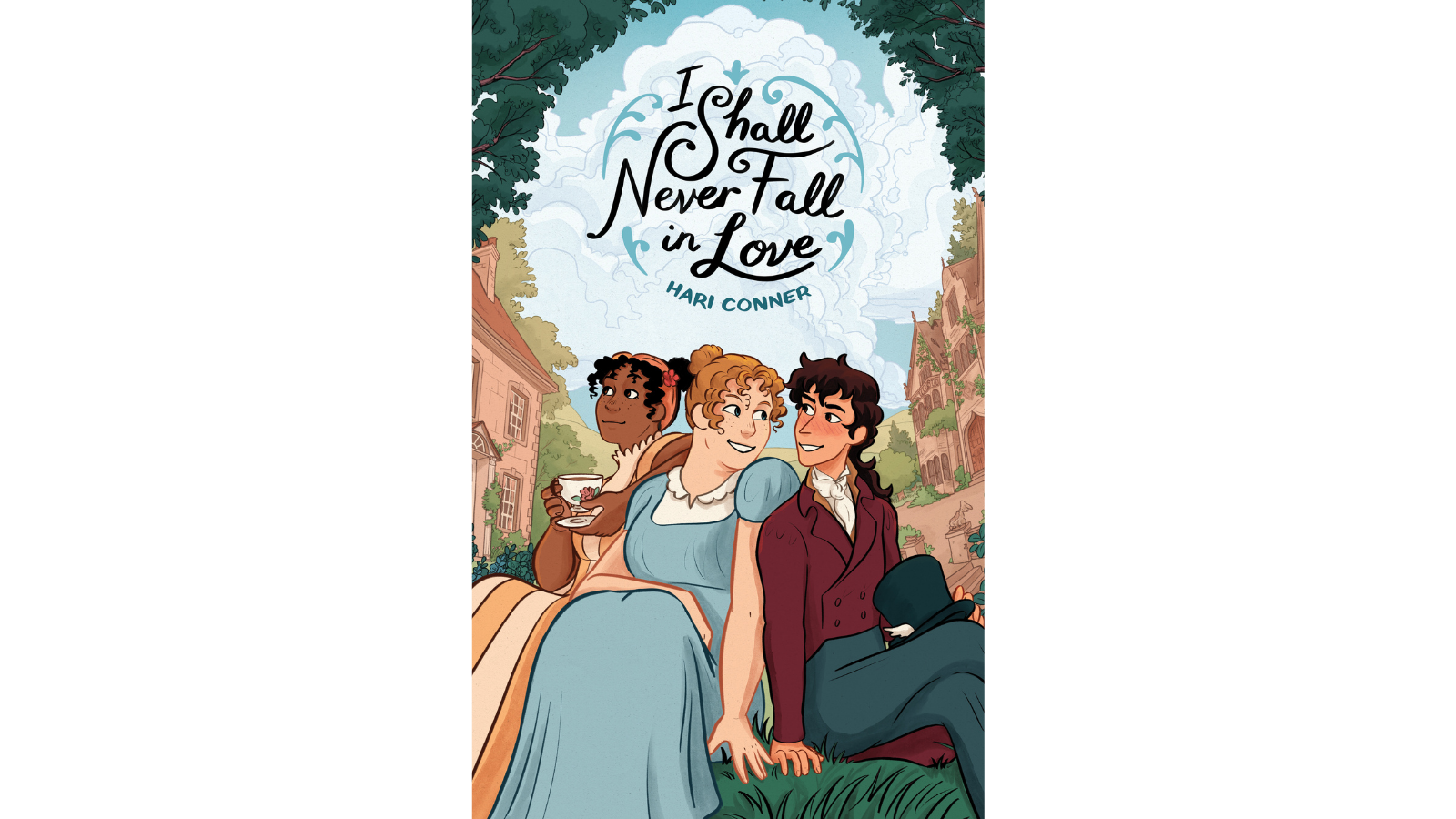
I Shall Never Fall in Love (nonbinary/cis f, historical, young adult, graphic novel) by Hari Conner. This book is so beautifully illustrated that my four year old demanded I read it to him.
Prior to this book, my kid’s library checkout history mainly consisted of books about trucks with the occasional I Spy or jigsaw puzzle thrown in. He does love Calvin & Hobbes despite most of the jokes going over his head. We had a brief foray into graphic novels with Susie Yi’s Cat & Cat Adventures: The Quest for Snacks, which everybody in our family loved. We read it nonstop for about three weeks. Sadly, in a later volume of the series, a character gets stuck in mud, and this was too much peril for my child. In distress, he took a break not only from graphic novels but also from the entire concept of narrative fiction, and we went back to reading catalogues of trucks.
I provide this context so you all understand that his request to read I Shall Never Fall in Love—a queer romance set in Regency England—surprised me. And then, when I started reading it to him and had to pause on every page to explain a word, or why characters were doing what they were doing, I expected him to get bored or frustrated and ask for a different book. Instead, he liked it so much that he extracted a promise from me not to read it without him, and then he proceeded to ask for it at every possible opportunity, every day for a week. When we finished, he said, “Now we can read it again!” We did, several times. He also read it with his father. In April and May, we read this book more or less continuously.
Please understand, my child is four. He does not know what the Regency era is. He doesn’t know what England is. (He only recently learned, after reading the letters “USA” on the side of our wheelie bins, that this is not merely the name of the company that sends the garbage truck to our house, but also the name of the nation where we live—a place that sorely needs its trash taken out, alas.) When characters blushed, my kid did not know what blushing was, or why a person would.
We have talked about sex and gender, but I don’t know that he has many firm ideas. Presented with the idea that he could be a boy or not, as he pleased, he chose boyhood. He keeps coming home from school doing the usual small-child boys-versus-girls stuff, but until fairly recently he was under the impression that everyone in the world had a penis. He was skeptical when I informed him that this was only true for about half the population. Then he wanted me to list every kid in his class who had one or didn’t, which I told him was none of our business. He gets people’s pronouns right most of the time, and I think his errors have more to do with language acquisition than gender.
I don’t mean to present him as too enlightened, though. On entering the library one day last year, he told me that he would only go downstairs to the children’s section “if the librarian is a he,” and that if there were any “shes” behind the librarian’s desk, he would not be consorting with them. I should have questioned this or pushed back, but parenting is hard and I fuck up like five hundred times a day, so instead I asked, “What if the librarian is a they?” (This is a real possibility at our library.) He thought about it for a moment and then amended his proclamation: he would go downstairs if the librarian behind the desk was a he or a they. So that’s how my child invented Woke Sexism.
(I am pleased to report that by now, he has made peace with the existence of she-librarians.)
Anyway, back to I Shall Never Fall in Love, which is charming even beyond its all-ages appeal. It stars three childhood friends: Eleanor, white daughter of country gentry; Charlotte, Eleanor’s cousin, who was cut out of the family inheritance because her mother is Black, but who has been taken in by Eleanor’s father to be educated alongside Eleanor; and their neighbor, George, born Georgiana, who lives in a crumbling manor house and is responsible for its care and that of the tenant farmers and surrounding farmland, since their father has passed and their brother is studying law in London. George is always “they” in their own thoughts, and the book deftly shows both their struggle with strict Regency gender norms and the recognition from other characters, who don’t use the same words we’d use in 2026, but still understand who George is. A few characters try to force George into womanhood, but many characters don’t. They respond instead with kindness, and set against all the other challenges George is facing, I found this really touching. I had to explain it to my charge several different times on different rereads, since we live in an era where wearing breeches isn’t an immediately obvious signifier of gender, and I think he appreciated it, too.
George and Eleanor are in love, which is obvious to everyone around them, especially poor, long-suffering Charlotte. George knows it, too—or rather, George knows their half of things and is tormented, thinking their feelings unrequited. Eleanor doesn’t know anything about herself except that she’d like to live up to the example of her late mother, who told her she’d get married one day, something Eleanor feels a curious reluctance to do. Perhaps she just hasn’t met the right man yet?
Eleanor’s mother also had rigid ideas about class and propriety, and Eleanor is sure she wouldn’t have wanted Charlotte to marry Robert Miller, a mere tenant farmer. But Charlotte and Robert genuinely like each other. Robert, unlike the upper-class men Charlotte meets at a ball in London, doesn’t have investments in Caribbean plantations that run on enslaved labor. (I had to explain many aspects of this to my four year old, as well as the word “abolition.”) He’s handsome and hardworking and kind. But Eleanor doesn’t think Robert is good enough for Charlotte, and also doesn’t quite grasp how Charlotte’s race makes it difficult to find the proper sort of suitor Eleanor expects, and this nearly breaks their friendship.
George helps Eleanor realize how wrong she is about Charlotte and Robert, and other characters help Eleanor realize how she really feels about George. It’s very satisfying. Some of that satisfaction comes from this book not being afraid to let Eleanor be really, really wrong—about things other than “I am not in love,” which is the chief job of a romance protagonist—and that’s a rare treasure in romance. She really fucks up. She tries hard to make it right, too.
There’s a wonderful cast of supporting characters, each very distinct: Eleanor’s anxious, ailing father; her friend, crush, and possible romantic rival, the lovely, accomplished Sophie; and her potential suitor, handsome ne’er-do-well Henry. In one of the novel’s best and hottest sequences, George threatens Henry into being a better person. It’s great. (I wasn’t sure my child was grasping all the complexities there—perhaps we’ll really get into blackmail when he’s five—but then I explained that if Henry didn’t act right, George was going to tattle and get Henry in trouble. It turns out small children understand blackmail just fine.)
This book is a real visual pleasure, too. The characters are so expressive that my kid always demanded we quickly turn the page past George’s aunt when her face was distorted with anger. And I feel this review would be dishonest if I didn’t say that George is a babe on every page. This book has no shortage of babes, but George is my number one.
They were my kid’s favorite character, too. This spring, sometime during our first reading of I Shall Never Fall in Love, his preschool class was visited by an entomologist. She brought a box of tiny plastic insect toys and the kids were allowed to choose one. My child came home and proudly introduced us to “International Space Station,” a plastic ladybug.
“Nice to meet you, International Space Station,” we said, marveling that our child knew the phrase “International Space Station,” and then, “Is International Space Station a he, a she, or—”
“International Space Station is a they,” he said emphatically. “Like George!”
This delighted me. I wanted to include a photo of International Space Station the nonbinary ladybug in this newsletter, but alas, they have suffered the fate of all tiny plastic novelty toys in our household, which is to be cherished for two weeks and then vanish into the unknown. Perhaps someday they’ll return to Earth.
In the meantime, our very well-loved copy of I Shall Never Fall in Love, intended for me, now resides permanently on my son’s bookshelf.
(In the months that I've been working on this essay, my kid got into other graphic novels! Sadly for me he's moved away from romance, but I do think I Shall Never Fall in Love really unlocked something for him. I'm thrilled that he likes fiction again. We are now continuously rereading Drew Brockington's CatStronauts series.
He has also, through exposure to Anthropeum and the World Cup, learned many nations of the world.)
That’s all for this time! I’ll be back in your inbox on August 2.
Also in August, in case you live somewhere near Cambridge, Massachusetts, I’ll be chatting with authors Megan Frampton and Loretta Chase at Lovestruck Books on Wednesday, August 26, at 7PM. It’s a release party for Megan Frampton’s book Demons and Diplomacy—more on this in a future newsletter! I hope you’ll get yourself a ticket and join us if you can.
Word Suitcase is a free newsletter about words and books. If you enjoyed this one, subscribe by email or RSS for the next one. If you know somebody who'd like reading these, please pass it along!
Websites do cost money, so there is a paid subscription option and a tip jar for one-time donations. If you feel moved to support me, I’m very grateful. But please don’t feel obligated. I love having you as a reader either way.