
Gazogène
resistance and romance novels

GAZOGÈNE, n. I ran across this French word in Nancy Wake’s autobiography The White Mouse. It’s a charcoal-fueled automobile, like this 1938 Citroën Berline 11. They were used in World War II because gasoline was in such short supply. They couldn’t go very fast or very far before you had to stop to refuel, and they were prone to blowing up, so people didn’t continue using them after the war. I had no idea such a thing ever existed.
Wake, born in Aotearoa/New Zealand and raised in Australia, moved to France in the 1930s, married a wealthy French industrialist, joined the French Resistance in WWII, and became a hero. I requested her book from my library system in the spring or summer of 2025, around the same time I was reading a biography of American French Resistance member Virginia Hall. Despite me being the only person on the waitlist for The White Mouse, it took a year for my hold to come in, so I assume the battered paperback copy I read is the only one in all of western Massachusetts.
It’s a short book and a riveting read. Wake is a jovial, opinionated narrator, and somehow every single page contains the most bonkers anecdote you’ve ever heard in your life. It’s impossible, but it’s true. She’s gorgeous, enthusiastic, and competent, and her superpower in life seems to have been making friends—everywhere she goes, she meets people who love her and are willing to trust her. This was also something I took from the biography of Virginia Hall: anti-fascist networks are built on friendship. I don’t want to downplay the factional violence that happened within the Resistance, in which people of different ideological stripes sometimes killed each other instead of fighting Nazis, but to celebrate something extraordinary about Nancy Wake. It was not an easy time to make friends.
In addition to her skill with people, Wake also relies on some skills that you won’t ever see in a James Bond film. She’s always feeding people, going out of her way to illegally raise a black-market pig for pork and sending parcels of food to people she knows in prison. And in one memorable story, when she’s working for the Pat O’Leary Line helping downed Allied airmen to escape, she and her friend Françoise shelter ten men in Françoise’s apartment. The men’s clothes are so dirty that it would raise questions at a laundry, so Wake and her friend have to spend days scrubbing them clean by hand. Spy laundry! Bond could never. I bet Kim Philby and Oleg Gordievsky couldn’t, either.
Wake and her fellow Resistance members are always suffering eighty-six different kinds of misery, freezing in the woods or escaping over the Pyrenees or being held in jail, but she recounts this with a sort of shrug and then goes back to telling you the various hijinks they got up to in between heroisms. And every now and then she’ll briefly mention some life-shattering horror. It’s staggering, what she lived through and what she accomplished.
Wake worked closely with, and was good friends with, openly gay Resistance radio operator Denis Rake, who also appeared in the biography I read of Virginia Hall. Wake calls him “Denden,” which I love. As far as I can tell, Wake and Hall never encountered each other during the war, though both were SOE agents for a time and both worked with the Maquisards.
Hall and Wake’s groups were separated geographically by a distance that would be easy to traverse in peacetime, with good roads and a functional vehicle, none of which they had. The gazogène comes up in Wake’s autobiography because a farmer offers her a ride in his and she worries that she will be caught if she rides in a motor vehicle on main roads, since there are Nazi checkpoints everywhere. She and her fellow Maquisards mostly get around on foot or by bicycle. In one spectacular instance, Wake rides from the village of Saint-Santin to Châteauroux and back in three days, taking a circuitous route to avoid being caught.
She did accept the ride in the gazogène and was neither caught nor blown up, for which the whole world should be grateful.
In small-r romance, here’s what I’ve read lately:
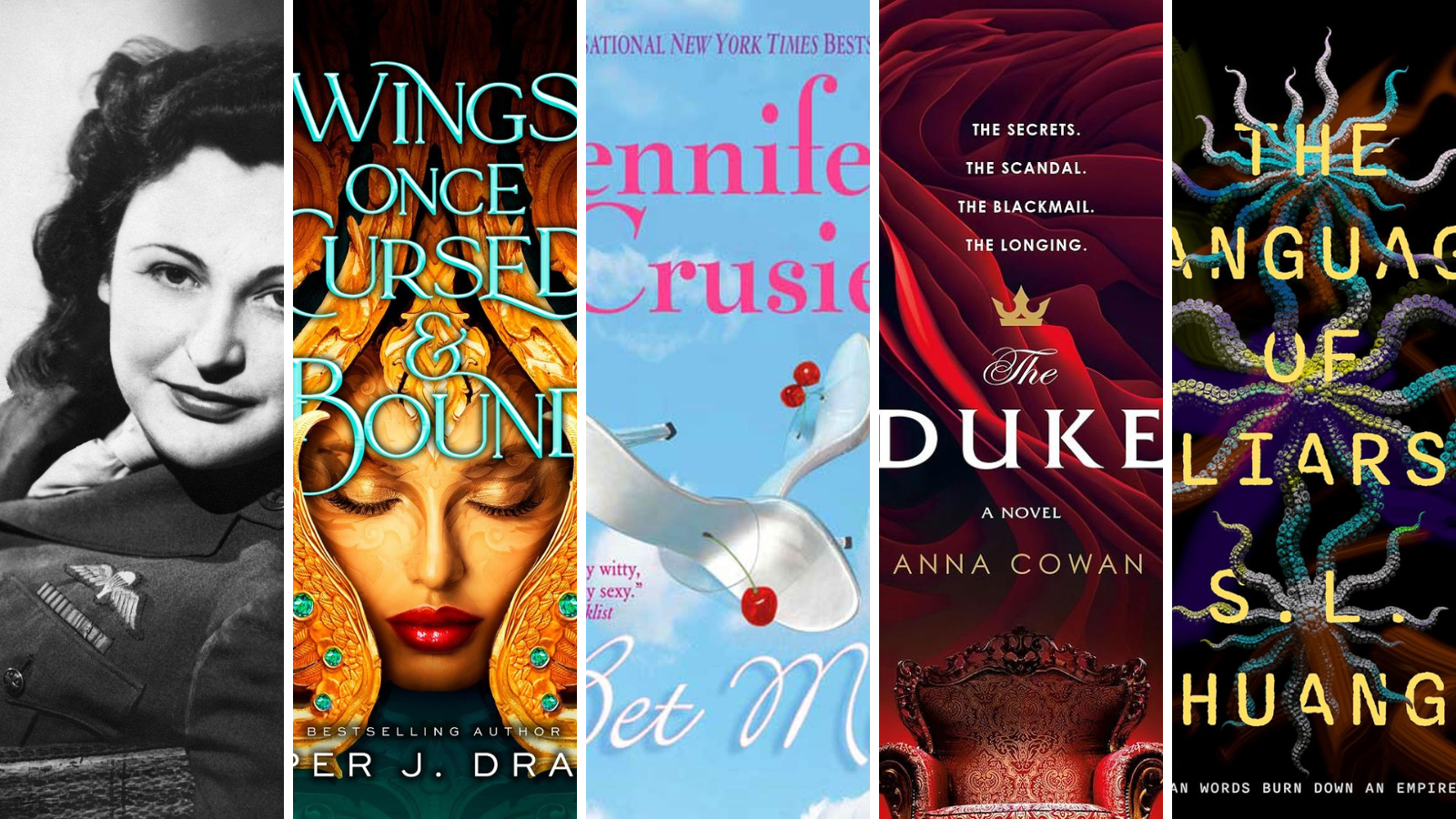
Wings Once Cursed and Bound (m/f, both cis and het, paranormal/contemporary fantasy) by Piper J. Drake. I had always meant to read this, and I finally picked it up because Drake tragically passed away earlier this year. Paranormal romance is one of my first loves, and I love that this one goes beyond the usual vampires and werewolves to include creatures from other folklores. The Thai American heroine is a kinnaree, a bird woman renowned for dancing. She is, in her normal life, a professional dancer, but she gets tricked into a wearing a pair of cursed shoes that will force her to dance until she dies of exhaustion—unless the handsome vampire hero can intervene to save her life. Love the cast of supporting characters and their secret organization dedicated to removing cursed magical objects from human society, and love that the next book in the series seems like it’s queer and polyamorous. I’m saddened that Piper J. Drake isn’t with us anymore, but glad we still have her books. Library ebook.
Bet Me (m/f, both cis and het, contemporary) by Jennifer Crusie. I’ve reread ten or twelve novels this year. I haven’t written about the others—presumably you all don’t need me to tell you again how much I love T. Kingfisher—but I am going to write about this one. I revisited this classic of the genre; it was published in 2004 and I first read it in 2010 or so. When was the last time I read a contemporary romance that had such deliberate, playful recurring ideas/allusions/comedic bits? I can’t tell you. Bet Me has a gambling theme (this probably felt more fun and harmless in 2004 when people were not carrying around a little gambling-addiction machine in their pockets and world leaders were not doing insider trading by making Polymarket bets on when they’d drop bombs, but ignore me, I’m ruining my own review) and a fairytale theme, both used to marvelous effect. There’s fate, there’s probabilities, there’s statistics, there’s chaos theory. There’s slippers and mirrors and pumpkins and poisoned apples, two wicked mothers, and of course, true love’s kiss. Also, Elvises Presley and Costello. (I’m a huge Elvis Costello fan! I don’t think his œuvre lends itself easily to romance novels, as his songs are primarily about tramping down the dirt on Margaret Thatcher’s grave, or telling stories of dysfunctional heterosexual relationships, which are often dysfunctional due to the man doing organized-crime and/or espionage-related fuckery, I think because we haven’t tramped down the dirt hard enough on the world’s various Margaret Thatchers. But anyway. Jennifer Crusie is making it work.) Bet Me feels ambitious and expansive compared to so much of what’s out there today—this book has ideas, it has a big cast of characters, it has a plot, I’m making myself sad with this list so I’ll stop—and it executes its ambitious plans with cleverness and grace. This is beautifully crafted and unputdownable. One of the all-time greats? But what do I know. And yes, technically this book from 2004 is no longer contemporary. I wish I could say that the book’s critique of the vicious diet culture of the ‘90s and ‘00s feels unnecessary in our enlightened era, but unfortunately, we don’t live in an enlightened era. You will feel the 2004-ness of the book when the heroine listens to her answering machine, but that’s a charming historical detail. What matters most is timeless: this book still fucks. Incredible stuff. Ebook purchased from Amazon long, long ago.
The Duke (f/f, both cis and lesbian, alt-historical) by Anna Cowan. This is a delicious homage to old-school historical romance—big feelings, lush prose, betrayals, intrigues, redemptions, a clever and determined young woman from nowhere, a cold and haughty duke—with one change: the titular duke is a woman. In this alternate history, England has a few titles that pass to “female lords.” This is considered a curiosity by the rest of Europe. In much discussion of this book, I’ve seen readers express puzzlement that the female lords are never explained, nor are the social codes of a (somewhat?) queer-normative Regency England, or how inheritance works for queer aristocrats, since naturally the property-owning classes would care about that first and foremost. But here’s the thing about me, as a reader: if I am having a good time, I simply do not care about these questions. And I was having a very good time. This book opens in Revolutionary Paris, where our heroine Céline, French courtesan, learns that her protector’s about to get guillotined, so she makes a desperate plea to seduce an English Duke in the hopes that said duke will spirit her out of the city. The Duke accepts her sexual advances, then abandons her. Three years later, Céline shows up in London with blackmail material, demands to presented to polite society as the Duke’s marriageable ward, and we’re off. Céline is brilliant and ferocious, Kate is cruelly closed off and looks good in buckskin, they betray and blackmail each other and yet are tortured about it. I’ve read and enjoyed all kinds of bananas premises in straight historical romance without questioning them, and I’m fine to take that same approach here. And this book is having such a good time taking classic romance hero archetypes and adding “but this time, it’s a woman” and so am I. Cold haughty duke, but this time, it’s a woman. Dissolute rake, but a woman. Terrifying piratical mercenary, but a woman. I will confirm my subscription, thank you very much. Library ebook.
In things that are neither romance nor Romance—though it does have a lot to do with linguistics!—I read SL Huang’s sci-fi novella The Language of Liars and it was brilliant. If you like your sci-fi full of fun speculation about language and your aliens very, very alien, I highly recommend it. It deals with questions of power and morality and bodily autonomy, and has a protagonist doing something extremely fucked up while still being lovable, which is a kind of magic, I think. It’s tense, compelling, and satisfyingly twisty. I love when a piece of fiction gives me all the clues to solve a mystery and I manage to do it a page or a few paragraphs before the protagonist. (I only try to solve language-related mysteries in books. If a character gets murdered, that’s somebody else’s problem.) Even the dedication is written like a dictionary entry, so obviously I loved it.
There are still a few hours left in the Romancing the Vote charity auction, raising money for Vote Riders and the Southern Coalition for Social Justice, two organizations fighting for voting rights in the United States. You could swoop in and place the winning bid on any number of signed books, cool crafts, or Zoom conversations with experts—for democracy! Or if the cutthroat competition of auctions isn't your thing, there are many "buy it now" items. Romance novelist and former SCOTUS clerk Courtney Milan plans to give a video presentation entitled "Samuel Alito is a whiny pissbaby," so obviously I bought a ticket for that.
And I donated some of my work! There's a print copy of Errant, signed by me and my two wonderful co-authors, KR Collins and Valentine Wheeler. And I spent many hours annotating my solo work, so there are three trilogies in the auction: The Gardener's Hand, The Nowhere, and French Letters.
That's all for this time. I will be back in your inbox on July 19.
Word Suitcase is a free newsletter about words and books. If you enjoyed this one, subscribe by email or RSS for the next one. If you know somebody who'd like reading these, please pass it along!
Websites do cost money, so there is a paid subscription option and a tip jar for one-time donations. If you feel moved to support me, I’m very grateful. But please don’t feel obligated. I love having you as a reader either way.