Propagating the faith
propaganda and romance novels

PROPAGANDA, n. This word has an extremely specific origin, and I had no idea. It’s from the Catholic Church’s Congregatio de propaganda fide, Congregation for Propagating the Faith, which was a committee of cardinals responsible for foreign missions. The committee was established in 1622, and by 1790 people are using the word “propaganda” for any organization propagating ideas.
Then, per the Online Etymology Dictionary, by World War I “propaganda” is “information intended to promote a political point of view.” They say the WWI-era usage isn’t pejorative, or implying that the information in question is misleading. It’s hard for me to imagine a use of “propaganda” that isn’t pejorative, so I’ll just have to trust them on that.
I am going to form a new Congregation for Propagating the Faith, but this time the mission is getting as many people as possible to read Isaac Fellman’s novel Notes from a Regicide, reviewed all the way down at the bottom of this newsletter.
But first, since I am always Propagating the Faith of romance novels, here’s what I’ve read lately in small-r romance.
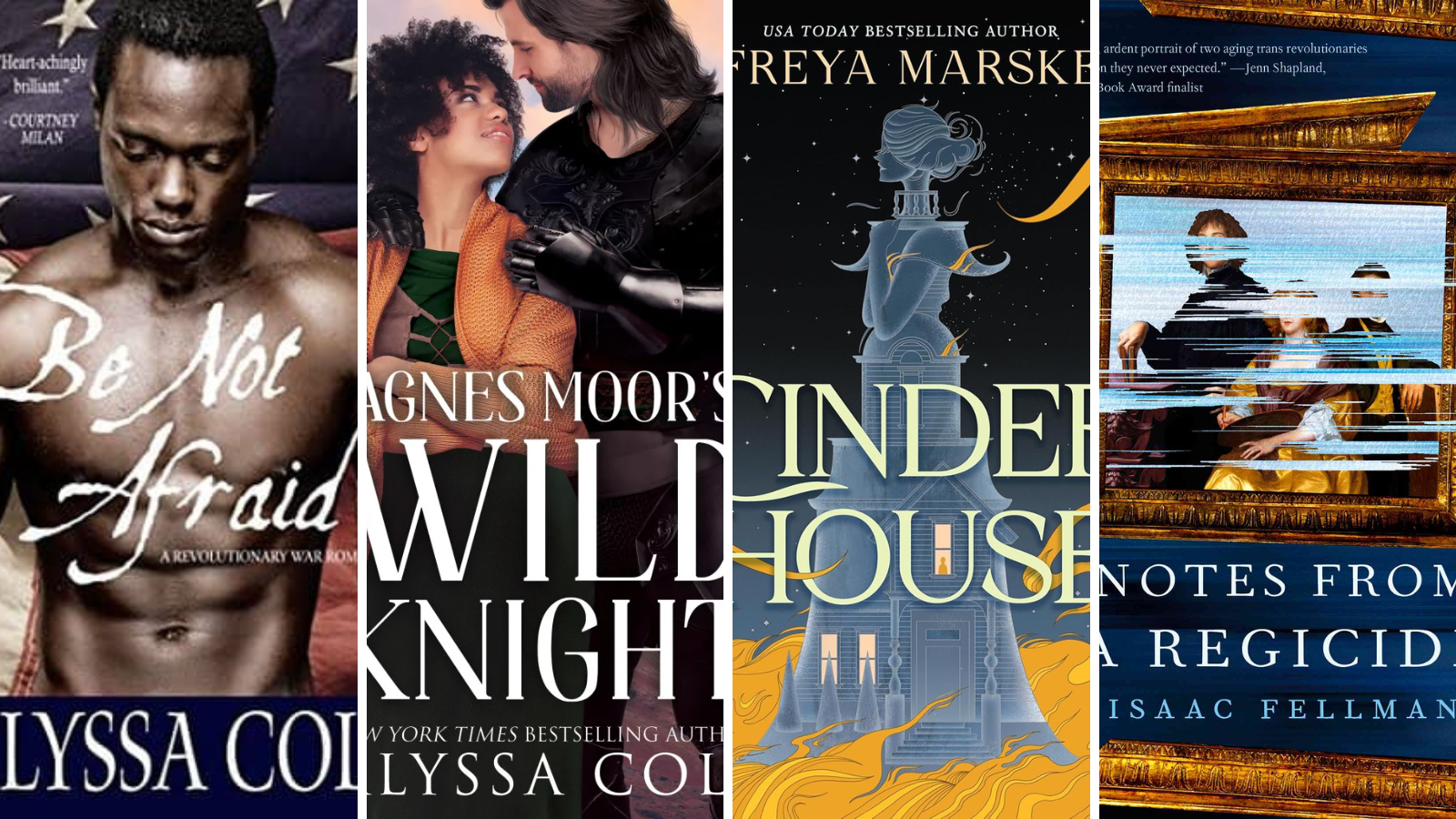
Be Not Afraid (m/f, both cis and het, historical, novella) by Alyssa Cole. I was recently reminiscing about how much I love Alyssa Cole’s writing, which made me realize she had a couple of works of short fiction that I’d never read. This one is set during the American Revolution. Elijah is an enslaved Black man whose master has promised him freedom and land if he fights for the Continental Army. Kate is an enslaved Black woman who works in a Loyalist camp. She hates America and is counting on the British promise of freedom at the end of the war. So they’re both in difficult circumstances, to severely understate things, and have lived through terrible trauma. (Kate has lost a child.) They begin the story at odds with each other, in an impossible situation, and it’s amazing to see them fight their way out and choose each other, despite the world. There is heartache in this, but there is also happiness. There can still be happiness. Let us not forget that. Library ebook.
Agnes Moor’s Wild Knight (m/f, both cis and het, historical, short fiction) by Alyssa Cole. This is set in Scotland in… 1507 or 1508, I think? And apparently based on a real historical event, where there was a tournament whose victor would win a kiss from a Black woman. It’s lovely to see Cole write that Black woman as an individual, Agnes, and imagine what her life might have been like. This is a very fun short story, and I love that it’s participating in the long genre romance tradition of Highlander heroes. Library ebook.
Cinder House (bi girl-ghost-house/? cis m/bi cis f, fantasy, novella) by Freya Marske. Ella was murdered by her stepmother, and now, as a ghost, she’s trapped with her awful stepmother and stepsisters, who can order her to do all their chores. Ella sometimes looks like a girl-shaped ghostly apparition, but she is also the house itself. She can feel things in her hearths and her walls and her windows. One day she devises a way to get free of this—at least until midnight, that fairytale hour—and subsequently meets a fairy godmother and gets herself invited to a ball. The mixture of familiar elements and new ones surprised and delighted me, and of course everything Freya Marske writes is done in beautiful prose. Library ebook.
In things that are neither Romance nor romance, I read Isaac Fellman’s Notes from a Regicide, which is a sci-fi novel framed as a journalist, Griffon, writing a memoir about his late parents, who were trans revolutionaries from a mysterious eternal city. Griffon is their adopted trans son, rescued from his abusive biological father (“Our family doesn’t reproduce by fucking, but by emergency”). His memoir is interpolated with sections of his father Etoine’s memoir, which Griffon has, he tells us, translated from a language that none of us would know, and additionally, edited and rearranged for clarity.
A note on the translation. Etoine wrote in his native language, Portois. Portois is a small language; it is spoken nowhere else on earth. It descends from English as it was spoken a thousand years ago, and French as it was spoken sixteen hundred years ago—the French of the old Quebecois, for Stephensport is in that part of the continent. It is mutually intelligible with contemporary English and French, but only just.
[...]
I abhor both the phonetically rendered accent and the convention of noting “he switched to Portois; she switched to English” in spy novels and novels of suspense, and so I have rendered both the Autoportrait and their dialogue entirely in English. If at times their language seems peculiar to you, you may imagine that they are speaking my language in their awkward way. If they grow eloquent, you may imagine that they are speaking in Portois. You may not always be right.
This is my catnip. Instalove is real and I felt it at that moment.
And then Notes from a Regicide is gorgeously written, just unbelievably vivid, sensual prose, clever and profound. This is a book about transness, of course, and it’s also about family bonds and trying to understand your parents:
You must understand that at all times, I wanted this couple to scoop me into their arms, except for when they did, which was my cue to wriggle and break away and shout at them and run to my room
On top of that, it’s about making art—both of Griffon’s parents are oil painters—and what art is, and what propaganda is:
“Three hundred years later, when the people who used it are dead, can propaganda go back to just being art again? I mean, is it like sand, where once it’s glass, you can’t make sand anymore? Or is it more like water, where it can melt or turn to steam or back to water or whatever?”
I don't know the answers to these questions, but I love them.
There is so much more: the cost of revolution, living with trauma, addiction, and mental illness, and love in all its forms, messy and fierce and necessary. There are two marvelous romances—Griffon’s and his parents’. This is a long way from genre romance, since both Etoine and Griffon’s mother Zaffre are dead, but they manage to have many years together before that, which feels like a triumph. It’s really such a beautiful book. And on top of all that, it’s funny:
When I shyly told Marino this last week, he cackled and quoted, “All women become like their mothers. That is their tragedy. No man does. That’s his.” Then he waited for me to quote the next line, but unfortunately, I am completely illiterate.
(It’s an Oscar Wilde quote, a line from The Importance of Being Earnest.)
So anyway, yeah. This is one of the best books I’ve read this year, and I’ll be thinking about it for a long time. I hope this was effective propaganda for convincing you to read it. Library ebook but I think I’m gonna buy a print copy. Apologies if my citations are punctuated incorrectly; my loan ended so I’m working from my notes, not an actual copy of the book.
That's all for this time! I'll be back in your inbox on July 5 to tell you about reading a romance novel with my preschooler (yes, really).
Word Suitcase is a free newsletter about words and books. If you enjoyed this one, subscribe by email or RSS for the next one. If you know somebody who'd like reading these, please pass it along!
Websites do cost money, so there is a paid subscription option and a tip jar for one-time donations. If you feel moved to support me, I’m very grateful. But please don’t feel obligated. I love having you as a reader either way.