
The Perpetrator
on obscure word origins, by which I mean where my child learns the things he knows, and, of course, romance novels

PERPETRATE, v. This verb usually means to commit a crime, or something else undesirable. You could also use it in a more neutral way, “to perform an action,” or in an ironic one—the OED quotes Charlotte Brontë talking about two characters who “perpetrate a duet.”
It’s not especially etymologically interesting, coming straight from a Latin word that means to carry through, or perform, an action.
What is interesting, to me at least, is that my preschool-age child came home one day and named one of his plastic toy cars “the Perpetrator.” Is this car especially menacing, or likely to commit illegal or immoral acts? Not that I can tell. Does my child even know what “perpetrate” or “perpetrator” mean? He has refused all questions on the subject. Where did he learn this word? He’s not telling, so it’s anyone’s guess. I don’t think we said it in front of him, but I couldn’t swear in court. We asked his teachers if they had recently read aloud any books that featured the word “perpetrate,” and they were baffled. I gather it’s not a common vocabulary word in children’s books.
Is it possible that my child—who, to brag, is kind of a conlanging prodigy, and regularly invents plausible-sounding nonsense words—simply put together some likely syllables and came up with “Perpetrator,” which to him indicates only a red-and-green plastic car? That is to say, did he perpetrate this word?
(Yeah, yeah, children inventing nonsense words is a normal part of language acquisition. You hush. Mine is special.)
And here I shall perpetrate some small-r romance reviews.
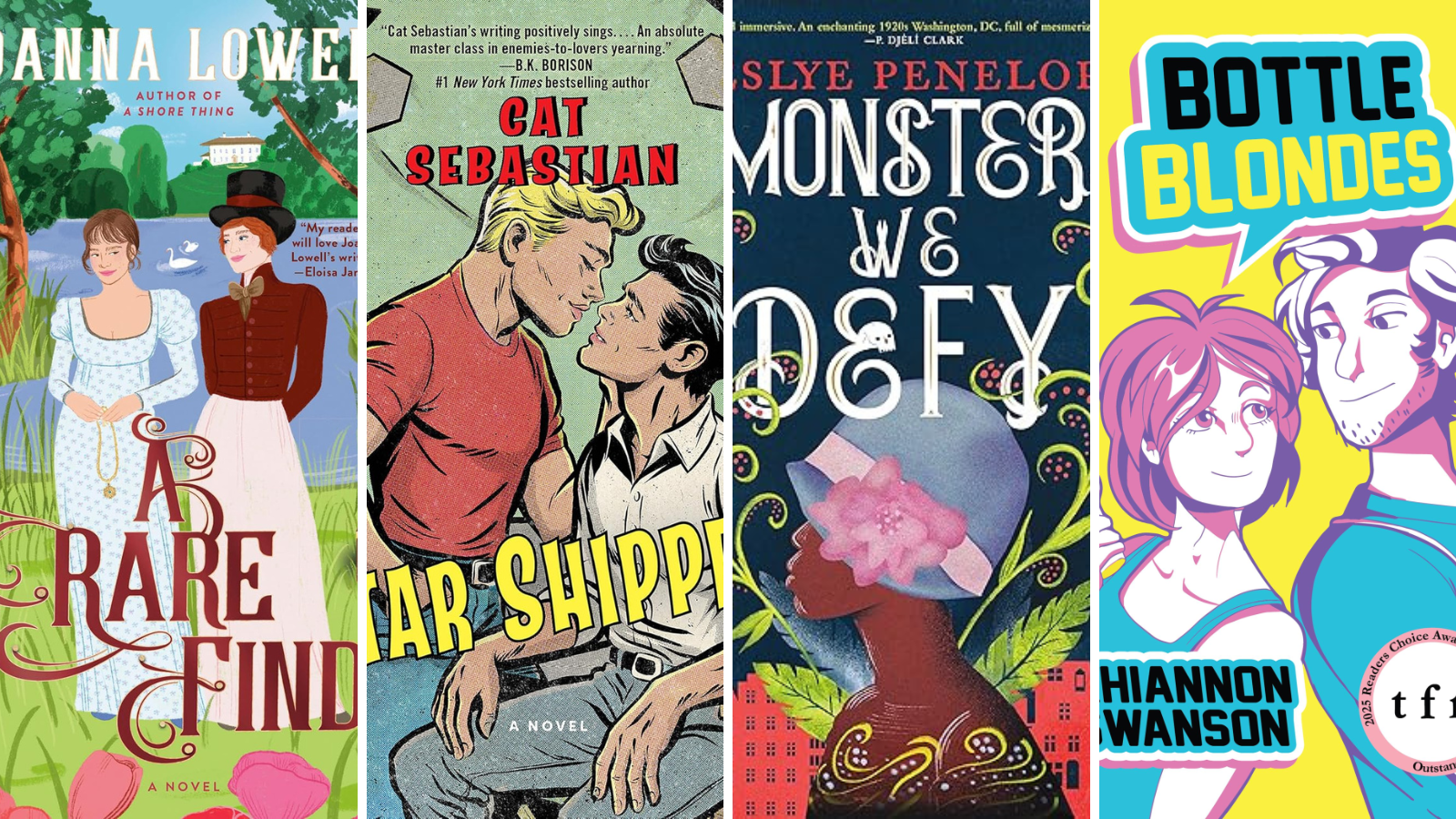
A Rare Find (nonbinary/cis f, historical) by Joanna Lowell. Georgie is a fun-loving, scandal-prone socialite with lots of queer friends, and Elfreda is a friendless, socially anxious would-be archaeologist, if only her awful father would ever give her credit for all the work she does on his digs and publications. Elf and Georgie did not get along as children, and now that Georgie’s back in the countryside following a broken engagement in London, they still don’t get along. In the beginning of the book, Georgie pushes Elf into a pond, causing Elf to drop a Viking amulet she’s just dug up, and it’s sort of an accident—Georgie mistakes Elf for someone else—but I still found the loss of the amulet pretty hard to forgive. However, Georgie is hot, and this helps Elf forgive them, which worked for me, too. Then there’s a lot of kissing mixed in with a little riddle solving and treasure hunting. I did ultimately enjoy this book, but not quite as much as Lowell’s marvelous A Shore Thing, and I sorely missed that Elf’s father, a real villain, doesn’t get the public humiliation he deserves. Read for my library’s queer romance book club, but purchased from Kobo because I’m not great at time management.
Star Shipped (gay m/bi m, both cis, contemporary) by Cat Sebastian. I knew I wanted this book immediately after seeing a brief description of it—two actors on a cult sci-fi show with a loyal fandom discover that they might have real feelings for each other—plus the words “Cat Sebastian.” Still I was not prepared for how much I loved this. Simon, the point-of-view character—let’s be real, I might as well call him “the Spock one,” you know what I’m talking about—is the most delicious combination of terrible (cranky, prickly, fussy, mean) and endearing (he’s suffering in secret, I love him so much, also his mean jokes are all funny and therefore allowable). And he’s paired perfectly with Charlie (the Kirk one, obviously), who seems like 100% lovable sunshine but has a mean streak that comes out for Simon. I smiled uncontrollably the whole time I was reading this. I think Cat Sebastian has always been funny, but the humor jumps to the forefront here in a new way. It’s perfect, I could’ve read it forever. Purchased from Kobo.
The Monsters We Defy (m/f, both cis and het, fantasy, historical) by Leslye Penelope. This is a heist story, so the focus is on the crew, their stories, and what they’re stealing, but there is a lovely romance as well, and the setting—Washington, DC’s large, stratified Black community in the 1920s—is gorgeously written and researched. The magic is rich, too. It’s drawn from Black folklore and traditions and it feels powerful and dangerous and mysterious. Clara Johnson is a furious young woman who’s lived through too much and is just trying to keep her head down and survive, but she’s connected to the spirit world and can’t refuse when people ask her to contact the spirits for help. Through her work, she learns that some of the city’s poorest Black residents are afflicted with an unknown supernatural illness, and many go missing. Clara doesn’t want to mess with the spirit world, but eventually she’s forced into solving the case—which will require her to steal a magical ring off the finger of one of DC’s most celebrated Black women, the opera singer Madame Josephine. The crew she gathers together, and the Fairy Balls and Vaudeville shows and fancy galas they sneak into, are vivid and wonderful. Purchased from Kobo. I also listened to a little bit of the audiobook, which I had from the library, and the narrator is great.
Bottle Blondes (cis m/trans f, both het, contemporary) by Rhiannon Swanson. This is a fairly long book, but I couldn’t put it down. It has such a sympathetic main character that I read it a couple of sittings. Sebastian is in his first year at college, suffering through life in South Carolina until he can get somewhere else, which will be better in some way he can’t quite articulate to himself. He only really feels happy when he’s with his friends Lucy, Anna, and Margot, three beautiful girls who have adopted him. They all think he’s gay, which he isn’t. He does tell them stories about David, the star quarterback who sits next to him in his acting class and asks for his notes, but that’s not relevant. Sebastian’s friends all go off to parties he can’t get into, not being a beautiful girl or a frat bro or a star quarterback. And then, through a series of increasingly complex justifications and mishaps, Sebastian’s friends convince him that maybe he should try on their clothes, and their makeup, and a wig, and the name Viola, and come to a party. Where, of course, Viola flirts with David, who flirts back. Eventually, she admits to herself that she doesn’t want to be Sebastian at all, and then she has to figure out how to get herself out of the double-life situation she’s created. Viola really goes through it, but I loved seeing her figure it out. Her friend group is great, as is the older trans woman she eventually gets mentored by. The Shakespeare references and Viola’s text logs with David are equally entertaining. This is a great time. I did have my usual uncool parental reaction of worrying about how much these young people are poisoning their livers with alcohol, but… that is a thing young people do, sometimes. And I can see why Viola might have needed to get drunk. Her biological family is awful, but she finds new people who love her. And her romance with David is so sweet. Ebook purchased from Antithesis Press. I found this book through Skye Kilaen’s Queer Romance newsletter, which is a great resource if you’re looking for new indie- or small-press-published queer romances.
That's all for this time. I'll be back in your inbox on June 7.
Word Suitcase is a free newsletter about words and books. If you enjoyed this one, subscribe by email or RSS for the next one. If you know somebody who'd like reading these, please pass it along!
Websites do cost money, so there is a paid subscription option and a tip jar for one-time donations. If you feel moved to support me, I’m very grateful. But please don’t feel obligated. I love having you as a reader either way.