
Pipes and other hollow dreams
my writing process—and also, happily, other people's romance novels

SONGE-CREUX, n. On Bluesky, Sarah JH Fletcher recently asked me why I named the house in The Anonymous Letters of C Forestier “Songecreux.” I did answer this question on Bluesky, so apologies if you already saw it. Since the answer has some etymology in it, and social media posts evaporate, I thought I’d share what I wrote in this newsletter—with more standard punctuation.
When naming anything in a novel, my first priority is always “Does it sound cool?”
In this case, the second thing I was looking for, in a house name, was a French noun that had also been used as a family name. That made “Songecreux” feel more possible as a place or house name. As a name it's usually without a hyphen, whereas the noun form is songe-creux.
In French, songer is a verb meaning to dream or to wonder/think/reflect on. Creux is an adjective meaning empty or hollow. A hollow dream, or rather, the person who dreams them.
I first encountered "songe-creux" in Montaigne's Essais (there are three publication dates, each with new text added because Michel de Montaigne, my relatable friend, never stopped editing his own work, but let's go with 1595). He identifies himself as one in Que philosopher, c'est apprendre à mourir (To philosophize is to learn to die), which is also the essay that I quoted in the novel's epigraph, because it feels... relevant. This particular Montaigne essai is a favorite of mine and it has come up in this newsletter on a prior occasion.
Montaigne describes himself as a "songe-creux," in a passage where he insists that he is not melancholy but has always been inclined to think about his own death, even when he was young and "parmi les dames et les jeux" (among ladies and games), sort of as a way of taming his fear and feeling freer. Montaigne's usage is pretty idiosyncratic, I think, though other people at the time are using songe-creux to imply some kind of melancholy reverie. Per the Trésor de la langue française, it's already pejorative by 1611, so it would be sort of a weird thing to name your house, but shhh.
“Songe-creux” later takes on even more negative connotations: the dreams are empty, unreasonable, impossible; the person dreaming them is useless or wicked. The TLF has a couple of nice literary examples so I'm gonna share them, with very off-the-cuff translations into English. (In theory, during the writing of this newsletter I could have perfected these translations, but W. S. Merwin* called translation “the unfinishable art,” and he was right. Michel de Montaigne would agree.)
Here's Zola using it in Germinal (1885):
Ces songe-creux de révolutionnaires pouvaient bien démolir la société et en rebâtir une autre, ils n'ajouteraient pas une joie à l'humanité
These daydreaming revolutionaries might demolish society and rebuild another, they would not add one joy to humanity
(I think “daydreaming" is less negative than "songe-creux" but I'm hesitant to put, I dunno, "pipe-dreaming" into that sentence, just for sound reasons.)
And here's Victor Hugo using it in Les Misérables (1862), where you can really see the utopian connotation:
C'était une mécanique bonne à pas grand'chose, une espèce de joujou, une rêverie d'inventeur songe-creux, une utopie
It was a piece of machinery that wasn't good for much, a sort of toy, an inventor’s pipe dream, a utopia
(Hugo is talking about a steamboat. He's being ironic. This passage comes from the chapter on the year 1817, so from his perspective, decades later, he certainly knew steamboats had uses.)
Most of this is thoroughly outside the scope of the question “why is this fictional house called Songecreux,” but I do love a dictionary entry.
A nice thing about writing in English and being able to name stuff in French is that I never could've named this place, like, The Bad Dream House. But also I could and I did.
If this were a straight-up secondary world fantasy novel, it could've been Dreamhollow—if I were really going for it. (Translating with proper word order would give Hollowdream, but since a hollow can be a place, I’ll allow it.) So anyway, that’s why it’s called Songecreux.
That concludes my paraphrase of what I wrote on Bluesky, but I also wanted to add, since I used the phrase “pipe dream” above, that I looked it up while writing this. Pipes are hollow, so I wanted to know if there was any connection between songe-creux and pipe dream. I didn’t find one. Regarding “pipe dream,” of course the pipe in question is an opium pipe. But my first exposure to this phrase was the Microsoft Windows 3.1 game Pipe Dream, which I played as a child, and the image of a goo-filled metal pipe stuck. So anytime I’ve run across “pipe dream,” I’ve been imagining some kind of impossible plumbing situation instead of the cloudy ideas people dream up in an opium haze. Now that I know better, I will not be correcting my own initial assumptions. It’s plumbing from here on out.
*Unfortunately, I can’t find the work where WS Merwin said "the unfinishable art," if indeed he did. I don’t think there is a proper bibliographic form for “my own memory of a long-ago panel at the annual conference of the American Literary Translators Association.” But “the unfinishable art” is a perfect phrase so I have kept it in the newsletter. Citationless behavior. Shameful.
Bonus etymology: readers of this newsletter are likely to enjoy Tal Lavin’s meditation on why we call Meleagris gallopavo “turkey,” and why so many languages all over the world have trouble naming this bird.
Also, I just read a gloriously weird and funny short story about murder turkeys, and the timing feels like a sign that I needed to put both of these turkey-related links in here. It's by Sharon J. Gochenour, also known as romance author Juniper Butterworth/J. Winifred Butterworth.
Here's what I've read recently in small-r romance:
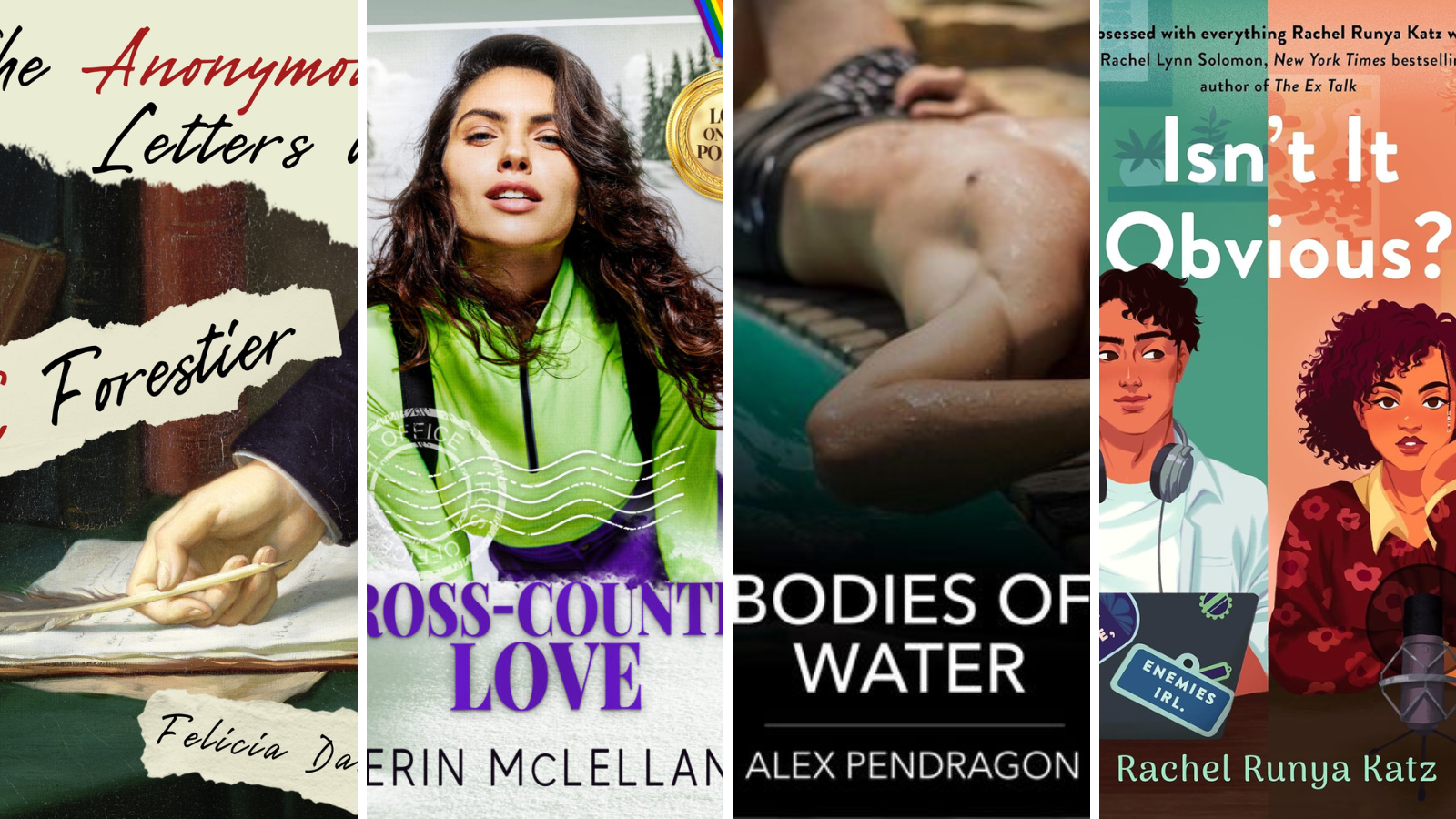
Cross-Country Love (bi f/lesbian f, both cis, contemporary) by Erin McLellan. I didn’t read this Winter Olympics romance in time for the Winter Olympics, but I promise it has year-round appeal: two women skiers with opposite personalities—a perfectionist ice princess and a drama-loving attention hog—find themselves locked in a furious rivalry. They clash in front of the cameras and smash when no one’s looking. It’s hot, it’s fun, it feels like they genuinely dislike each other in the beginning, but of course they can’t stop thinking about each other in a Kate Beaton’s Hark! A Vagrant type way. I don’t know anything about skiing, but thought it was used to great effect in this story. I love Erin McLellan and was so thrilled to see a new book from her that I broke my rule about not purchasing from Amazon. Indie published; ebook purchased from Amazon, which is the only place it’s available.
Bodies of Water (no-labels m/gay m, both cis, contemporary, erotic) by Alex Pendragon. This is so hot and has such great banter between the main characters, Tate, a man in his late 30s getting over the end of a 16-year relationship, and Kai, a med student in his early 20s who just really, really wants to use his neighbor’s pool, if you know what I mean. Tate hasn’t really healed from his break-up, and doesn’t believe that youthful, fit, perfect Kai could genuinely want him, especially not for an actual relationship, so Kai spends the whole book working hard to prove it. The sex scenes have a great balance of physical and emotional intensity. Indie published, bought from itch.
Isn’t It Obvious? (m/f, both cis and bi, contemporary) by Rachel Runya Katz. What a gorgeous book. I’m always going to be an easy sell for “these two people dislike each other in real life without realizing that they love each other online,” but a good premise doesn’t make a good book, you know? What makes a good book is vivid, memorable characters, big feelings, and great writing, and this one has all three. It delivers so much delicious dramatic irony and angst, but it’s also sweet and sexy and funny. Yael is a high school librarian in Portland who has a podcast—for which she doesn’t use her real name—that critiques classic high school reading like Catcher in the Rye and The Great Gatsby. She needs an audio editor and a graphic designer, so her friend in NYC recommends a colleague who just went freelance. He and Yael instantly connect over email, and then text, and they share a lot more than editing notes on the podcast. He’s kind and considerate and has absolutely nothing in common with Ravi, the guy Yael caught sneaking out through her bedroom window after he had a one-night stand with her roommate Charlie. Ravi is awful, obviously—except he volunteers to help Yael run her after-school queer book club, for which she’s legally required to have another adult present. I loved the book-club kids and Ravi’s four-year-old niece, which is notable because I have a lot of real-life experience of four year olds right now, so I would find it grating if this book did it wrong—but it doesn’t! His niece is a cute and believable preschooler. A lot of care went into crafting this book, from the supporting-character kids to the Portland setting to Yael and Ravi sharing little bits of their cultures with each other (she’s Black and Jewish, he’s Indo-Trinidadian). That sounds pat, maybe, or tokenizing. But since I recently tossed aside a romance novel that had a supposedly French character saying “la curiosité a tué le chat” (literally “curiosity killed the cat”), as if French speakers and English speakers use identical expressions instead of each language having its own treasury of idioms that vary across geography and generations, it was refreshing to read Ravi joking with Yael that “yuh cyah make love on a hungry belly,” which this book taught me is a Trinidadian expression meaning that love doesn’t put food on the table / poverty can cause relationship problems. It felt right that these two characters, who are both bookish and whose relationship was largely epistolary, would care about words and language. Now I feel like I’ve made this book sound like homework, which is no good, because what I should be telling you is that it’s an up-past-my-bedtime, fun-as-hell, captivating read. Library ebook.
That's all for this time. I will be back in your inbox on May 24.
Word Suitcase is a free newsletter about words and books. If you enjoyed this one, subscribe by email or RSS for the next one. If you know somebody who'd like reading these, please pass it along!
Websites do cost money, so there is a paid subscription option and a tip jar for one-time donations. If you feel moved to support me, I’m very grateful. But please don’t feel obligated. I love having you as a reader either way.