
Less reck
recklessness, romance, and several entries in the Vorkosigan Saga

RECKLESS, adj. I recently read a book to my four year old that included the word “quadruple,” and he asked, “Is that how you say ‘four’ in Spanish?” He’s making connections between languages! I kvelled.
On the other hand, he was goofing around at breakfast, knocked over his cup, and splashed my beloved, who then said, “I know it was an accident, but do you know what ‘recklessness’ is?”
To which our child yelled, “No, and I do not want you to tell me!”
(Is this, perhaps, a reaction to having a parent who talks about words too much? I couldn’t possibly say.)
I did respect his wish—we had to get to school—but naturally I looked it up and I have to tell someone, so thank you for being here, dear newsletter readers.
“Reckless” is “careless,” basically. They have that same “-less” suffix that means not having something. Careless, without care. Reckless, without… reck?
“Reck,” as it turns out, is an archaic English verb meaning to take care of, or to heed. The OED has an interesting note that going all the way back to Old English, “reck” was almost always used in the negative, or in questions. It’s a passive-aggressive “do you even care” sort of verb, so it makes sense that it’s survived mainly in the negative adjective “reckless.”
On that note, I’ve been wondering if it’s possible for any romance protagonist to get through their story without a moment of recklessness. I think maybe not? I think the form sort of requires them to go “oh, fuck it” and take a big risk at some point, even though they all start out carefully guarding their hearts. (But I’m open to counter-examples, if you can think of romance protagonists who were careful and sensible all the way to their Happily Ever After.)
Here’s what I’ve read lately in small-r romance:
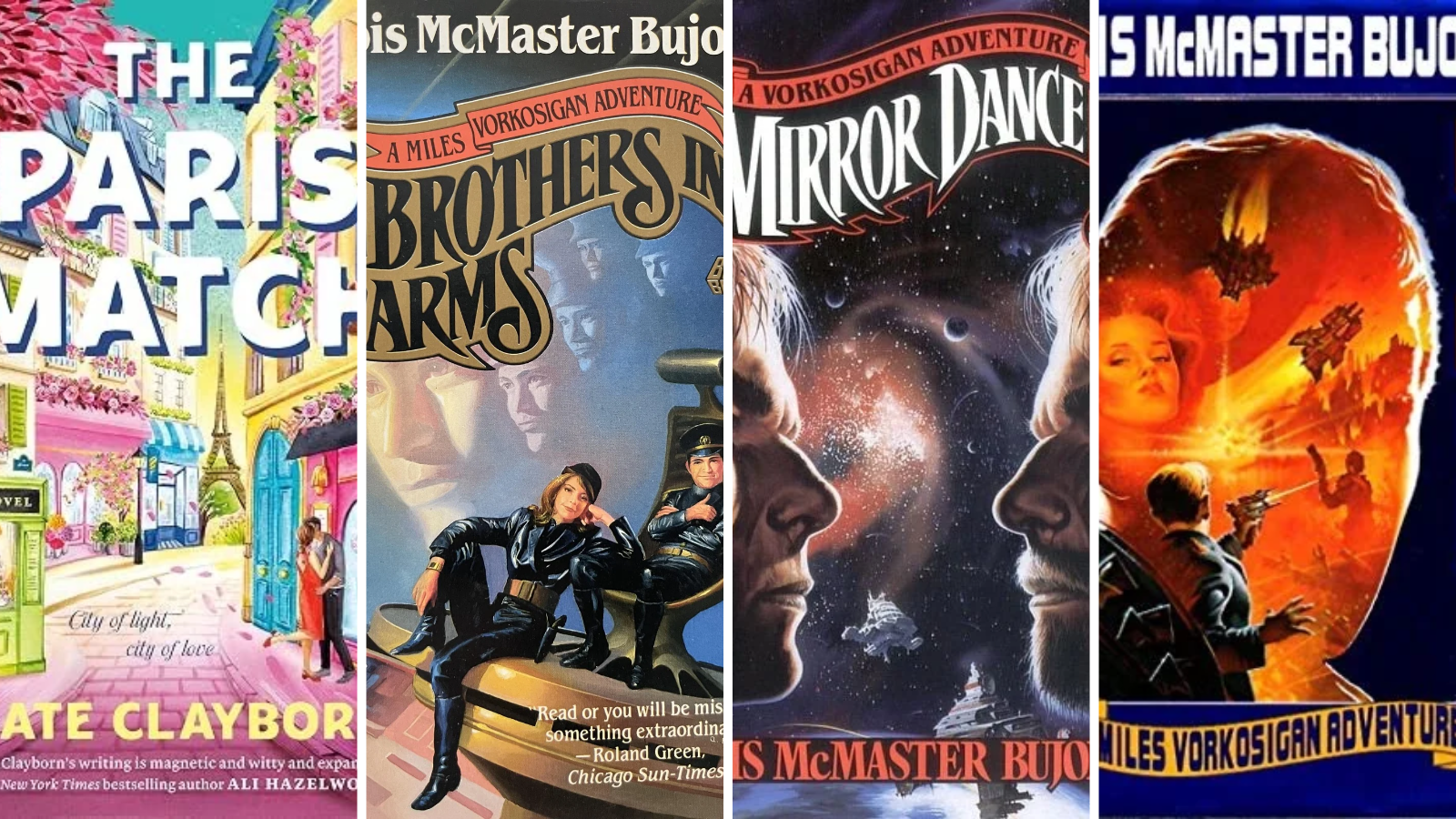
The Paris Match (m/f, both cis and het, contemporary) by Kate Clayborn. Listen, this is a Kate Clayborn novel, by which I mean to say it’s splendid and I loved it.
As an aside, when I returned my ebook, Libby (the library app) offered me AI-generated suggestions for things I might like to read next, based on this book’s qualities, and one of the suggested qualities was “breezy.” I thought to myself: we have to do Butlerian Jihad. We have to smash all the computers. This cannot be allowed, calling Kate Clayborn’s magnificently observed, tender, agonizing, beautiful romance about pain and secrets “breezy.” How dare you. I would kill you with my own two hands. This machine would try to take my job and not even do it right? Infuriating. We don’t need a machine that recommends books; I am a machine that recommends books.
ANYWAY. Layla Bailey is flying to Paris for a wedding. The bride is a close friend, even a sister—except that Layla and the bride’s older brother got divorced, so they’re not family anymore. Layla is so anxious about the wedding that she’s made all kinds of planning spreadsheets and bought herself an entirely neutral wardrobe so she can disappear into the background. It is obviously a terrible idea for her to be going to this wedding, repressing all her misery behind “it was amicable,” and things get worse from there. The best man, Griffin, is mysterious and surly, and he’s very upset when it seems like the bride has cold feet. He blames Layla and makes her promise to help him fix it. Naturally, as they spend time together, their project of saving the wedding gives way to falling in love.
Griffin is heavily scarred, traumatized, and dealing with a lot of chronic pain, a subject this book handles with such depth. I think Kate Clayborn often takes on something that is commonplace in romance—like, say, an enormous muscular hero in The Other Side of Disappearing, or a mysterious scarred hero in this book—and gently prods the idea, shakes it, unwraps it, opens it up and examines everything inside, then repackages it so you’re still getting that thing—a book with a mysterious scarred hero, I mean—but in a way that feels far, far more examined than usual. Griffin is also rich, which elicits some excellent commentary while still being part of a fantasy (at one point, he buys Layla some very nice clothes).
Layla is a doctor, and on her flight to Paris, a teenage girl faints and Layla provides medical help. She’s a good, compassionate doctor, with excellent bedside manner, so she helps the girl calm down by asking about the book she’s reading. It’s a type of book that all romance readers, or possibly, in this romantasy-saturated moment, all readers will recognize: there’s a girl in love with a fae prince. This moment is written with great affection. It comes back later in the book, when Layla is thinking about her own darkly brooding, powerful, mysterious man, and I just absolutely beamed at that page. Callbacks are tricky—they can be clunky and over-the-top, or they can pass me right by if I missed the first one—and so is commentary on genre romance in a genre romance novel, but this was done with such a beautifully light touch. Everything in this book is like that.
Also, it’s wildly romantic. And set in Paris! And it honestly acknowledges that Paris smells like piss and cigarettes and yet, like a flawed romance protagonist, we love it anyway. Library ebook.
Also on the subject of recklessness, it’s time to talk more about Lois McMaster Bujold’s magnificent sci-fi Vorkosigan Saga. (For previous Vorkosigan books, this newsletter discusses the beginning of the series and this one discusses the next few.)
The recklessness applies to me, for how profligately I have been running through this series—I’m gonna be so sad when it’s over! I should be savoring them!—and also to… basically every single character in these books, at one point or another.
I’ve read so many that I’m not sure how to talk about the books without spoiling major developments. Half my project here is to squeal about these books with people who already love them, but the other half is to convince the rest of you to join us. So I don’t want to ruin any surprises.
Brothers in Arms (1989) takes place on Earth (“Old Earth”!), in London, which was a fun change of setting, and it has the wonderful Miles-and-Ivan sibling-ish relationship, which I always love, plus it introduces a minor character who’s very dignified and has no times for Miles and his covert ops shenanigans, but of course gets drawn into them anyway, ends up forever changed and also, naturally, friends with Miles. And it introduces a new major character that I have no idea how to talk about. Miles’s mom Cordelia isn’t on page in this one, but she is so present in all of Miles’s decision-making, and I love that. It’s rare for genre fiction to depict good parenting so attentively.
This new mystery major character narrates half of Mirror Dance (1994), which is just an absolute feat of a novel. Lois McMaster Bujold said “I am going to write this character doing something despicable and unforgivable on page, and then not only are you going to forgive him, you are going to love him,” and I was there the whole time, but I still don’t really know how she accomplished that. My God, did it work. There’s also a marvelous moment in this one with my beloved nonbinary intersex babe Bel Thorne, where the scene is not in Bel’s point of view, but is written such that you can read Bel’s thoughts even though the actual point of view character can’t, and this is the magic of really, really good characterization.
Memory (1996) is about Miles going home after the shattering events of Mirror Dance, realizing he’s middle-aged and needs a new career and kind of a whole new life, and figuring out who he’s going to be from here on out, while also solving a not-quite-murder mystery. It’s gorgeous. And we get to learn a lot about physically unimpressive but terrifying intelligence chief Simon Illyan, who turns out to be human after all, and who has the best relationship with Miles. And there’s Lady Alys Vorpatril, who is so much my favorite that I don’t even know how to express it. “Powerful socialite who wields power through her superior grasp of traditionally feminine arts and spheres, consistently underestimated by most of the men around her” is just one of the all-time character types. Alys Vorpatril would fit right into Balzac’s Comédie humaine. She could run Balzac’s Paris—and she wouldn’t even need a plasma arc to do it. I love her and her handsome unambitious son very much.
I borrowed the audio from the library and the paperbacks from a friend for all three of these.
I made another themed rec list—this one’s about math genius romance protagonists—and I started a giant list of all the indie authors I’ve reviewed in the newsletter, which I will try to keep up to date.
I’ll be back in your inbox on December 6.
Word Suitcase is a free newsletter about words and books. If you enjoyed this one, subscribe by email or RSS for the next one. If you know somebody who'd like reading these, please pass it along!
Websites do cost money, so there is a paid subscription option and a tip jar for one-time donations. If you feel moved to support me, I’m very grateful. But please don’t feel obligated. I love having you as a reader either way.