Ox turning
Writing forward and backward and upside down, in letters and telegrams and meows, and, of course, romance novels

BOUSTROPHEDON, adj., adv., n. This is a Greek word to describe a text that is written from right to left in one line and then left to right in the next line, and so on, alternating direction like an ox plowing a field. That’s what this word means: ox-turning. Some ancient Greek texts were written this way, which is why we use a Greek word to describe it, though Greek is not the only ancient language with boustrophedon inscriptions.
I recently encountered a new usage of “boustrophedon” in The Greatest Invention: A History of the World in Nine Mysterious Scripts by Silvia Ferrara, translated from Italian by Todd Portnowitz. Ferrara is discussing Rongorongo, the undeciphered script of Rapa Nui/Easter Island:
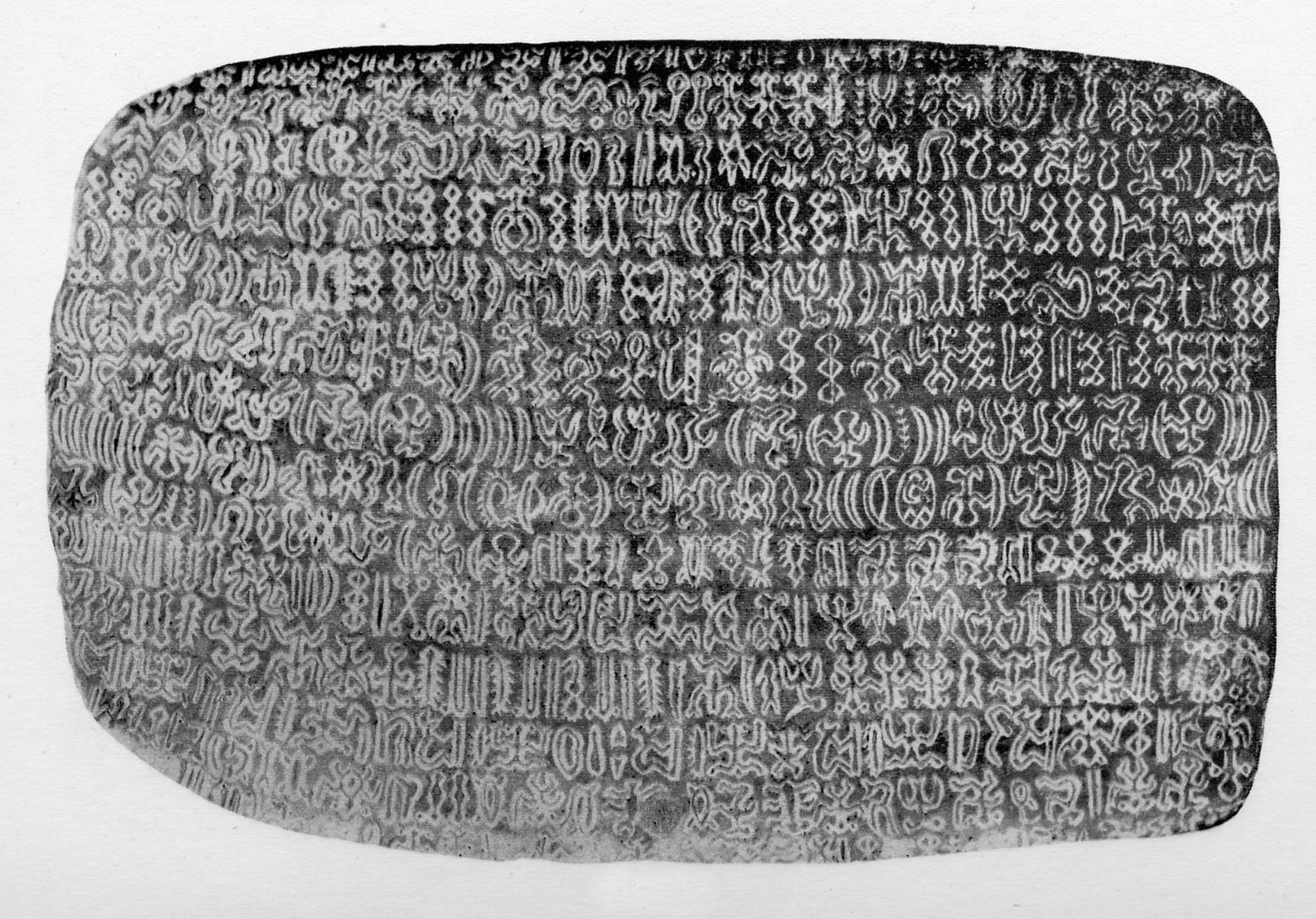
Rongorongo, however, makes things (and the lives of us decipherers) even more complicated, since it’s written in reverse boustrophedon: the signs in the second line are upside down with respect to the first, forcing the reader to turn the tablet over every other line. Not only that, but the language is read from bottom to top. It sounds truly strange, but reading a text was meant to be a kind of advanced choreography. (63)
Reverse boustrophedon! I didn’t even realize you could reverse an alternating zigzag, but obviously my imagination was limited. Here is an image of one of these tablets, Tablet C or the Mamari Tablet, sourced from Wikipedia:
Reading The Greatest Invention (2019 in Italian, 2022 in English translation) is like attending a lecture series by a beloved professor: it’s engaging, personal, even chatty. Ferrara makes wide-ranging references—she’s a Linear A and Cretan Hieroglyphs scholar who will also tell you about Pokémon. There is sort of a jump-scare moment when she brings up Elon Musk, but she does make fun of him a little. She is not nearly mean enough, but I won’t hold that against her; no one ever has been or will be.
(You are not obliged to complete the work, but neither are you free to desist from it.)
Ferrara is at her best talking about the ancient Aegean. I saved this bit on Linear A’s sign A80 to show you all, because first of all look at these wonderful cats:
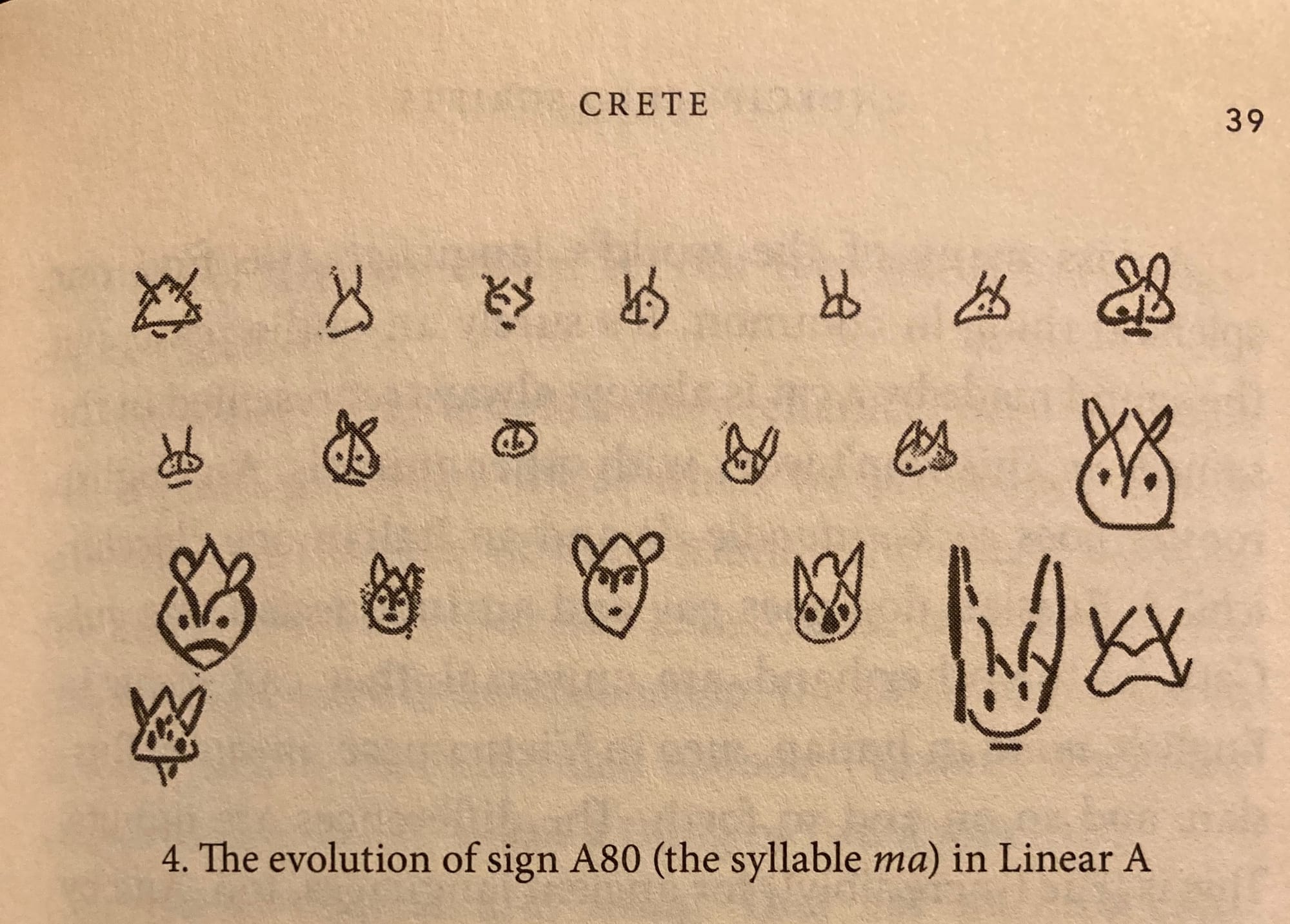
Across many of the world's languages, we find one splendid thing in common. It's surely an outlier case, but the sound made by a cat is almost always represented in the same way. This won't work with other animals. An English rooster goes cock-a-doodle-do and an Italian one chicchirichì! A Russian dog goes gav and an Indonesian one guk. Cats, on the other hand, are universal: they can meow in English, miao in Italian, meo in Vietnamese, myau in Russian, and so on and so forth. The differences are minute. This is true (incredibly!) for ancient languages, too. And by now you probably get what I'm driving at.
If I were a Minoan cat—with my beautifully open and simplified syllables, nearly all consonant-vowel pairs, as in Linear B (and Linear A)—what noise would I make? If I were a Minoan cat, I'd go ma. A resounding maaaaa, then, in the face of all the Minoan bulls that roamed the palaces.
Obviously I had to look up a list of cat sounds in world languages after reading that.
I’m not sure this book really achieves its “history of the world” subtitle, but it is a tour of the world’s undeciphered scripts, pausing intermittently to talk about some of the more famous deciphered ones, and it’s a great time.
There’s a clear and thorough explanation of the decipherment of the ancient Cretan script Linear B. While I appreciate her analytical approach, I should say that if you are a bigtime language nerd who wants to really savor the story of how people finally figured out Linear B, The Greatest Invention is not the book you want. Read Margalit Fox’s wonderful narrative nonfiction The Riddle of the Labyrinth instead.
Here are some small-r romance novels you can read beginning to end in one direction, though as for the course of true love, I’m told it goes back and forth.
The Quicksand Theatre Company (queer cis m/nonbinary, fantasy) by Molly Ringle. It was my pleasure to blurb this romance, which is an inventive contemporary fantasy set on the fictional island of Eidolonia, inhabited by a mixture of fae and humans on its shores, while its center is fully fae and incredibly dangerous to humans. Eidolonia is hidden from the rest of the world, yet still part of it, so they have their own cultures, but can still make Shakespeare references. Vai, who has just blown the whistle on their family’s corrupt business, runs away from home to join the titular traveling theatre company, hiding themself in the caravan of a performer named Leo. On hearing that Vai put themself at risk to expose their family’s illegal dealings with Eidolonia’s bigoted rightwing party, Leo accepts them as a roommate, and Vai joins the company. The two of them fall in love over the course of a few months, but unfortunately Leo has been hiding from Vai that he made a bargain with one of the island’s magical creatures, a vampire-like thing called a fair feaster, and soon he will have to go live in the island’s interior for a year. His chances of survival are not good; his chances of coming back unharmed are even worse. So Vai is blindsided by Leo’s deception and then they’re dramatically separated. This was such an adventure, and I loved the foreign-familiar magical world it was set in, and how delightfully queer and genderqueer it was. Advance reader copy. Out February 24.
Divine Rivals + Ruthless Vows (m/f, both cis and het, fantasy, young adult) by Rebecca Ross. This is probably slightly more fantasy than romance—be aware that it takes two full books for our heroes to find happiness, and also that there’s a pretty big focus on the sorrows of war and that secondary characters can die—but it does have a really central love story, so it’s in this newsletter. On occasion I gotta check out the sort of books that are getting three-quarters of a million ratings on GoodReads, as Divine Rivals is. These books have a cool, inventive setting: a fictional world with roughly WWI-era technology, but the trench warfare is happening due to the ancient enmity of two gods, who are real and walk the earth and use dragons to drop gas canisters. Iris Winnow is an aspiring young reporter, vying for the same job as born-with-a-silver-spoon Roman Kitt. He’s handsome, by the way. Iris is having a rough time since her brother went off to war and her mother started drinking, so she’s been writing secret letters on her grandmother’s typewriter, hoping someday her brother will write back. But the typewriter is magic, and the letters go to… Roman Kitt. He starts to write back to his mysterious correspondent, and an epistolary romance is born. Iris goes to the front to tell the truth about the war and look for her brother, and a lot of plot unfolds from there, including something I’m a big sucker for: what if we fell in love and then I had magical amnesia and forgot you? I loved how the letters played a few different roles, being burned or not burned, revealed at key moments, etc. So good. Library audio and print.
I also reread Adriana Herrera’s marvelous An Island Princess Starts a Scandal (f/f, both cis and lesbian, historical) for my library’s queer romance book club. I wrote about this book in 2023, but just wanted to mention it again because it really does have such wonderful description of 1889 Paris and the World’s Fair. And it’s hot. Ebook purchased from Amazon in a previous year, and they updated the cover from the old photo one to a new illustrated one that I like less, which is just one of many reasons I try not to buy ebooks from Amazon anymore.
Also, I just realized that all four of these books have epistolary elements!
Speaking of epistolary elements, sort of, in things that are neither Romance nor romance, I read Barbara Tuchman’s The Zimmermann Telegram, a history of the US entry into World War I. It was gripping even though I already knew how it would end. In addition to writing a great narrative history, she’s a careful, graceful prose stylist. Such vivid portraits of historical figures—some affectionate, some funny, and some caustic. So many turbo-racists in power during WWI, Woodrow Wilson among them. And this eerily familiar detail’s gonna haunt me:
…no one ever knew what to expect of the German Emperor. Bismarck said of him that “he wanted it always to be Sunday." Wilhelm's Byzantine court assisted him in this illusion by providing him with his own morning paper, in a special imperial edition of one, made up of carefully excerpted items from the world press, printed in gold.
Wilhelm was interested in gold-plated news only and disliked above all else those tiresome visits from ministers with their reports of inconvenient facts that did not fit in with his schemes. To avoid listening to them, the Kaiser would walk up and down, do all the talking himself, and dismiss the minister in twenty minutes.
I own several of Tuchman’s other books, including her other WWI histories, but have been a little daunted by their size. This makes me want to read them. Paperback purchased from Thriftbooks in combination with library audiobook.
One last thing for this newsletter: If you're around Boston/Massachusetts/New England on March 11, come see me talk to TJ Alexander at Lovestruck Books in Cambridge. A ticket to the event includes a paperback of TJ's new book A Lady for All Seasons, which you definitely want. You should buy the book even if you can't make it on the 11th.
A Lady for All Seasons is a deliciously funny, swoony, effervescent trans romance set in Regency England—more on this in a future newsletter. Suffice to say, it's dreamy and I'm so excited to chat with TJ about it. Also, I went to their last event at Lovestruck Books and can confirm they're funny and charming. You will have a good time.
And please do come say hello to me after the event—I would love to meet you!
I'll be back in your inbox on March 1.
Word Suitcase is a free newsletter about words and books. If you enjoyed this one, subscribe by email or RSS for the next one. If you know somebody who'd like reading these, please pass it along!
Websites do cost money, so there is a paid subscription option and a tip jar for one-time donations. If you feel moved to support me, I’m very grateful. But please don’t feel obligated. I love having you as a reader either way.