Gotelef
honeysuckle, Tristan and Isolde, and romance novels


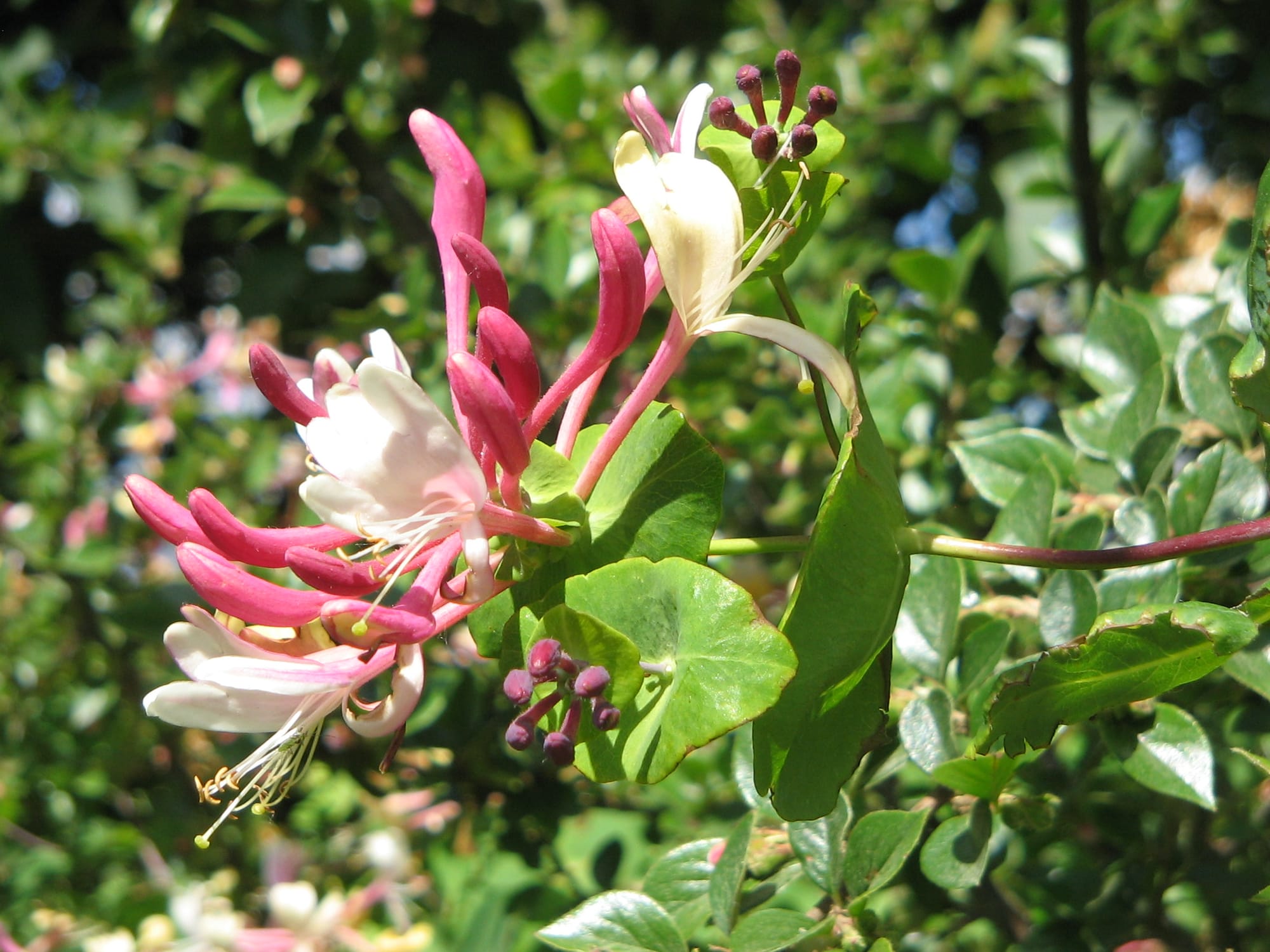
HONEYSUCKLE, n. Usually when we say this in English these days we’re talking about a climbing, flowering plant of the genus Lonicera, found in Eurasia and North America. The origin of the word is more or less what it looks like—it’s a flower that you can suck the honey out of. Some people did used to say “honeysuck” as the full word (and regionally, some English speakers still might).
There’s a little bit of uncertainty about the “-le” suffix, but it’s probably the diminutive sense mentioned in this wonderful OED note, which I’m quoting in full just for fun:
The Old English nouns and adjectives with l suffixes are probably in most cases of pre-English formation. The nouns formed on noun-stems have sometimes an originally diminutive sense, as in bramble; sometimes they express the notion of ‘an appliance or tool’, as in thimble, handle. In those formed on vb.-stems the function of the suffix is either agentive as in beadle, instrumental as in bridle, girdle, or expressive of some less definable relation, as in bundle. The adjectives, which are formed on vb.-stems, have the sense ‘apt or liable’ (to do what the verb expresses), as in brittle, fickle, gripple, nimble, †swikel.
(“Swikel” is an obsolete word meaning “deceitful,” from the verb “to swike,” to act deceitfully, also obsolete except for some lucky Scots. “Gripple” is from the verb “to gripe,” so “griping” or “miserly,” and I think it’s too bad we don’t say it anymore.)
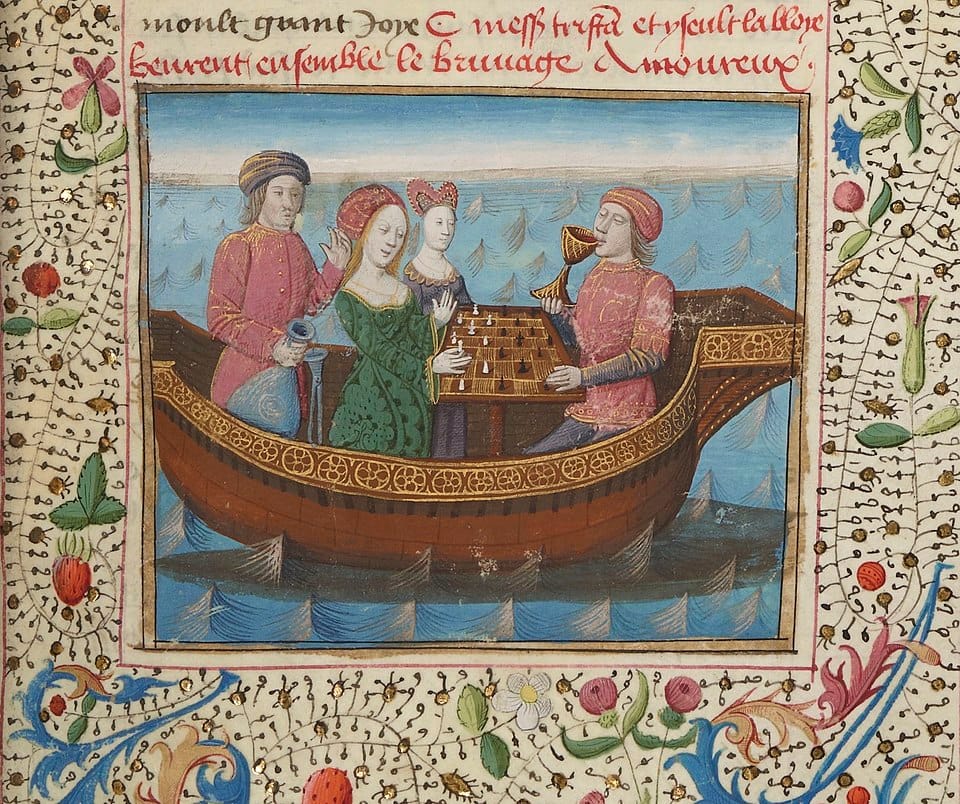
Back to honeysuckle: nothing is blooming here in snow-crusted western Massachusetts, but because of my romance-novel reading below, I’ve been thinking about the medieval romance of Tristan and Isolde, where honeysuckle is an important symbol. Marie de France’s 12th-century lai (a medieval poetic form that tells a brief story, often about love or magic, they’re wonderful) about Tristan and Isolde is called “Chievrefueil” or “Chevrefoil,” spelled “chèvrefeuille” in modern French, which means “honeysuckle.”
Marie de France helpfully explains its literal translation at the end of the lai:
Asez briefment le numerai :
‘Gotelef’ l’apelent Engleis,
‘Chievrefueil’ le nument Franceis. (Wikisource)
And in translation by Patricia Terry:
I will quickly say
How people referred to this new lai:
Gotelef in English (which became
"Honeysuckle") translates the name
Chevrefoil.
The OED lists “gotelef” (I love medieval spelling so much) under “goat leaf,” which is specifically Lonicera caprifolium. Apparently goats (capri-) love the leaf (-folium) enough that they’re in the scientific name.
It’s been a while since I put any Capital-R Romance literature in this newsletter. Always nice to reassure myself that I do still know how to read in (modern) French.
Tristan and Isolde famously don’t get a happy ending. The honeysuckle thing is actually about how they’ll die if they’re separated. Here’s Marie de France in Patricia Terry’s translation:
He could no longer live that,
Cut off from the one he loved, for they
were like the honeysuckle vine,
Which around a hazel tree will twine,
Holding the trunk as in a fist
And climbing until its tendrils twist
Around the top and hold it fast.
Together tree and vine will last.
But then, if anyone should pry
The vine away, they both will die.
“My love, we’re like that vine and tree;
I’ll die without you, you without me.”
The Old French is really great for those last two lines, plus it’s fun to look at Old French if you’ve never seen it before:
‘Bele amie, si est de nus :
ne vus senz mei ne jeo senz vus !’
And for those of us nerds who always want to read more than one translation, here’s another one by Judith P. Shoaf.
In need of happily ever afters, here’s what I’ve been reading in contemporary English small-r romance:
Of Socialites and Prizefights (f/f, both cis and lesbian, historical, fantasy) by Arden Powell. Deepa sings in a nightclub and makes men fall in love with her so they’ll buy her fancy gifts. She turns down proposals right and left, telling herself she’s simply waiting for the richest possible man, and she doesn’t believe in love, anyway. But then a rejected suitor curses her to turn into a leopard every night. The curse can only be broken by true love’s kiss. Deepa gets worried: no man has ever made her feel anything like love. Luckily, some friends take her to a lesbian club where she meets Roz, mechanic by day and boxer by night, and she has a few realizations. The curse still doesn’t break, and I was propelled through my reading, wondering exactly when it would. This is fluffy and magical. Indie published; purchased from Amazon in a previous year.
The Blonde Identity (m/f, both cis and het, contemporary) by Ally Carter. I keep reading books at the intersection of “spy story” and “romance” because that’s what I’m writing, and I want to see how other people do it. As I’ve mentioned before, I do have to pretend a book is set in an alternate universe when it deals with the CIA, but luckily this book does take place in an alternate universe, one where the main characters encounter a meter-high snowbank in Paris. Sure, okay. If you are willing to make allowances for climate, and politics, and physics, and all sort of other real-world concerns, there is a page-turner under that meter of snow. This book rarely lingers, which might sound good to you or not. I, known lingerer, wouldn’t have minded a tiny bit more, but you know, sometimes a book is doing its thing and can’t be derailed. The train is moving and we gotta push a bad guy down a mountainside, let’s go. Anyway, it’s got twins and amnesia and chase scenes and it kept me from looking at the news for two hours. Library loan.
Bitter Burn (m/m/f, all cis and bi, erotic) by Sierra Simone. Speaking of spy stories and romance, here’s one that definitely takes place in an alternate universe: a lightly magical contemporary setting that transfers Arthurian myth to the United States. I love Simone’s prose enough to tolerate a lot of sex stuff that I’m not personally into, but I couldn’t handle “the US president is King Arthur” as the premise of a romance trilogy (that one’s officially called New Camelot). Pain play? Rape fantasy? Fine, fine. But the US presidency is a hard limit for me. I mention this because Bitter Burn exists in this same imaginary realm, and as the third book in the Lyonesse trilogy—a kinky, queer retelling of Tristan and Isolde—it really ties itself to New Camelot. I was invested enough in Tristan, Isolde, and Mark that any time the presidency came up, I was able to go “lol, ok” and keep reading, but your mileage may vary. Anyway, this series takes the wicked king/uncle from the tale of Tristan and Isolde and makes him into an ex-CIA agent who runs an elite BDSM club as part of his elaborate revenge plot on the shadowy conspiracy that murdered his husband (because of course). Tristan is a sweet, noble-souled modern knight/soldier, and Isolde is a sort of princess/nun assassin. It’s bananas, but it commits, which I respect immensely. These three alluringly fucked-up babes have a lot of kinky sex and do a few murders. It’s deliciously written, from the feelings to the architecture to the bodily fluids. Everyone is rich and fashionable and talented at crime. There’s a chase scene in the medina in Fez, one of the best places I’ve ever been. The story wraps up nicely and is beautifully balanced among the three main characters, which I know from experience is hard to do. If you’re interested in this trilogy, I reviewed the first book, Salt Kiss, in a previous newsletter and apparently forgot to ever discuss book two, Honey Cut, but I did read it, and it’s as hot and angsty as the others. Ebook purchased from Kobo.
I will be back in your inbox with one more Word Suitcase in this calendar year on December 21.
Word Suitcase is a free newsletter about words and books. If you enjoyed this one, subscribe by email or RSS for the next one. If you know somebody who'd like reading these, please pass it along!
Websites do cost money, so there is a paid subscription option and a tip jar for one-time donations. If you feel moved to support me, I’m very grateful. But please don’t feel obligated. I love having you as a reader either way.