Fly off the handle
On the expression "fly off the handle" and, of course, romance novels

FLY OFF THE HANDLE, expr. So “to fly off the handle” means to lose your temper or to lose control of yourself more generally. I looked it up because I wanted to use it in my novel draft and wasn’t sure how old it was, where it came from, or what, exactly, flies off the handle.
The answers turned out to be straightforward: the expression originated in the United States, the OED’s first citation is dated 1832, and the thing that is flying off the handle is the head of an ax(e). Not something you want to lose control of!
As for whether the expression will remain in my novel, well, writing’s a choppy, messy, unpredictable process. A lot of things get cut. All I want is to finish this draft without getting hit in the face with a projectile axe head.
Sometimes the word part and the book part of this newsletter go together, but as you can perhaps tell from the above, all my efforts at coherence are currently channeled into my draft. So let me just tell you all about some small-r romance novels.
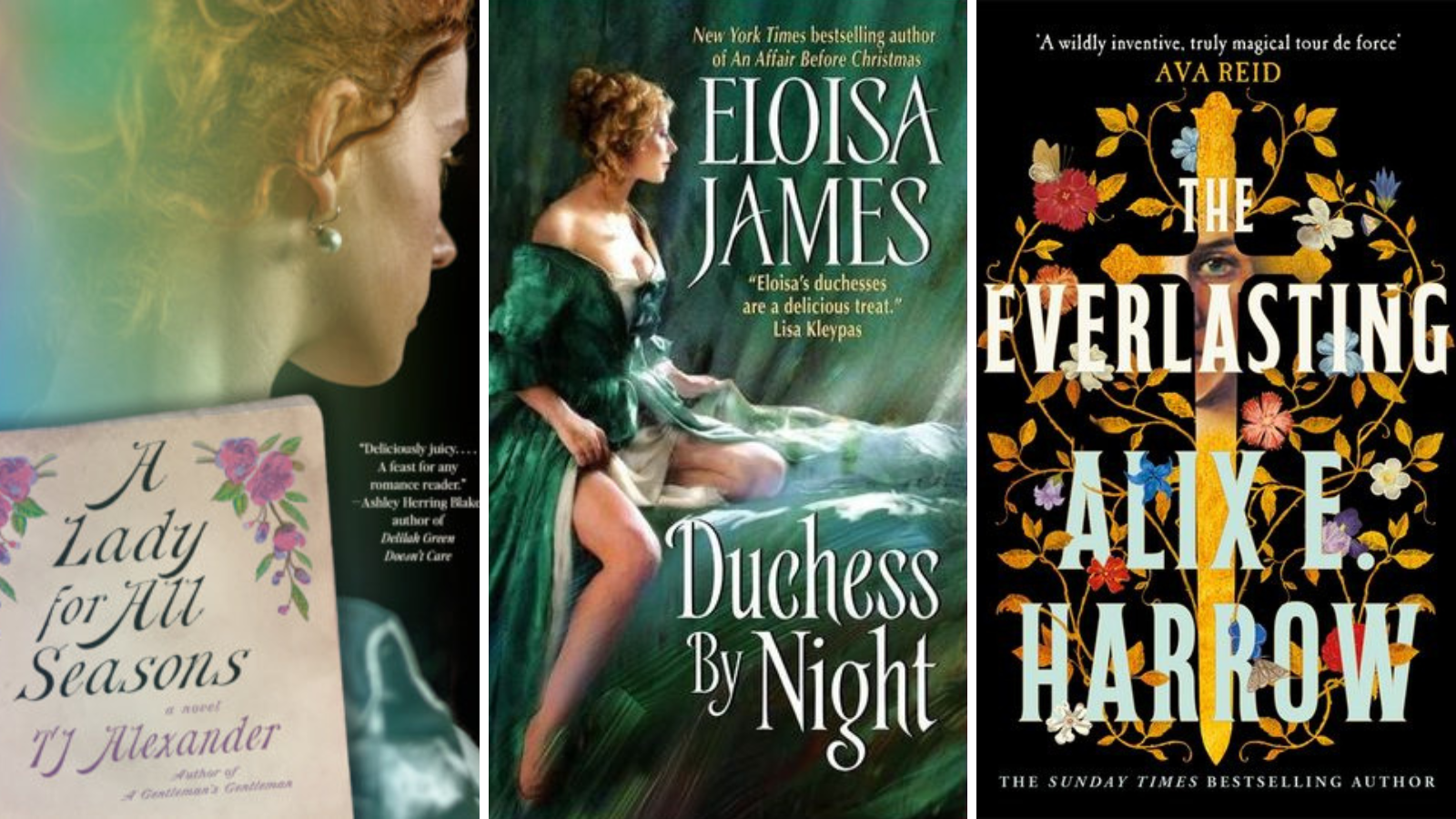
A Lady for All Seasons (cis f/nonbinary, historical) by TJ Alexander. Did you know that in the early nineteenth century—in England and France and probably other parts of western Europe that I know less about—novels were considered a low, feminine art form and poetry a vaunted, masculine one? That’s why it’s so delicious that this novel’s nonbinary protagonist is both gothic novelist William Forsyth and poetess Flora Witcombe; in both literary genre and binary gender, William-Flora is coloring outside the lines. Flora specializes in verses about society. Fortunately/unfortunately for her, she writes a poem with some damaging insinuations about high-society gossip queen Verbena Montrose, who confronts her like an avenging fury. Naturally, Flora falls in love. Clever, ruthless Verbena is a survivor. She’s not afraid to lie and scheme, and I love her for it. Verbena ends up at an eccentric artists’ retreat in the English countryside, where she’s determined to convince everyone that she and her gay friend Étienne are definitely for real getting married (to save each other from financial ruin and scandal, respectively) and also to matchmake her friend Flora with her other friend William. That way, she and Flora can each have a fake husband and conduct a secret affair with each other, and nothing could possibly go wrong. For some reason, Flora doesn’t care for this plan. This book has heaps of yearning, and all the secret-identity dramatic-irony shenanigans you could possibly want, and is funny and sexy besides. It starts delightfully queer and blossoms into more and more queerness as it goes along. Totally wonderful. Advance reader copy but I also preordered a print one. Out March 10. Come see me chat with TJ about this book at Lovestruck Books in Cambridge, MA, on Wednesday, March 11.
Duchess by Night (m/f, both cis and het??, historical) by Eloisa James. I thought it might be a fun project, while thinking about gender in historical romance, to read some older books that play with it. Also I’d never read any Eloisa James and it seemed like I should fix that. In her life outside romance novels, James is a professor of Shakespeare, and it shows in the book—there’s the As You Like It or Twelfth Night style crossdressing, of course, and quick-witted characters are always quoting plays. The first half of this book is fun as hell. The titular duchess (Harriet) disguises herself as a young man (Harry) so she can attend a scandalous house party. It turns out she loves being a man. But this 2008 book falls into a weird space where, okay, we all know gay people exist, that’s fine, I Have Gay Friends, there just aren’t any actual gay characters in this book. Certainly not any trans characters, certainly not our protagonist! The second half of the book is all about aggressively asserting that everyone here is very cis and straight, and Harriet will never be Harry again. After all that freedom, it’s a huge bummer. One of my professors in grad school once offhandedly remarked that many “comedies” featuring crossdressing are conservative; the action of the narrative correctively humiliates the character(s) who transgressed. I couldn’t stop thinking about that while reading this. I suspect it applies to a lot of “heroine in breeches” historicals. This one isn’t heavy on the humiliation, but there’s a lot of “I’m a woman and I’ll always be a woman and when you, a man, love me, it makes me feel like the woman that I am”/“I’m so in love with you because of how you are a woman and I am a man” kind of stuff in the back half. I’m no Shakespeare professor, but didn’t he say something about protesting too much? Purchased from Kobo. Also, there's pregnancy in this, in case you need a heads-up.
The Everlasting (het m/bi f, both so gender non-conforming as to confound my shorthand scheme, fantasy) by Alix E. Harrow. All stories are time loops. For those of us inclined to reread or retell, you can always go back to the beginning. It’s a little different every time, though. This experience is a lot more real for Owen Mallory, a modern scholar who gets sent back in time to the era of the legendary lady knight he studies, Una Everlasting. Una’s story is a tragedy, ending in her sacrificial death for Dominion, the nation that would outlive her. Dominion needs its founding myth. Una and Owen are trapped in it, doomed. Unless, perhaps…? The prose is gorgeous—especially delectable on repetition—and there’s so much good stuff about storytelling and history, with interpolated telegraphs and manuscript sections. And to keep this newsletter on theme, this book has a deft use of point of view, told by Owen (“I”) to Una (“you”) or vice versa, and that fluidity, that lack of “he” and “she,” plays very nicely with the all the pleasingly uncategorizable, subversive Gender going on here. When this novel’s two main characters go on the run through time together, it looks like this:
They even left their sexes behind, dressing sometimes as two men or two women, binding or stuffing their chests, lengthening or shortening their stride. This, at least, came easily to them, for neither of them had ever quite been what they were supposed to be, or acted how they ought to act. They were too manly or too womanish, too loud or too soft-spoken, too tall or too slim, too strong or too weak. It was no hardship to trade one disguise for another.
“Neither of them had ever quite been what they were supposed to be” is the story of the time loop, too. What Una and Owen were supposed to be—national hero, patriotic historian—has been beaten into them by repetition, but it’s a cage. It’s a tragedy. But sometimes what seems inevitable or immutable can be changed. Purchased in print from indie bookseller Side Quest Books & Games. Also, this book made me cry about parenthood (laudatory). There's pregnancy and loss in it.
That's all for this time. Next time, March 15: a 1993 mass-market paperback historical romance full of murder and peril!
And I'll be at Lovestruck Books in Cambridge, MA, on Wednesday, March 11, chatting with TJ Alexander about their latest book. If you're a trans person in the area who would like to come but can't afford a ticket, I would love to buy you one. Reply to this email and let me know!
Word Suitcase is a free newsletter about words and books. If you enjoyed this one, subscribe by email or RSS for the next one. If you know somebody who'd like reading these, please pass it along!
Websites do cost money, so there is a paid subscription option and a tip jar for one-time donations. If you feel moved to support me, I’m very grateful. But please don’t feel obligated. I love having you as a reader either way.