
Buildings and books
le livre et l'édifice, but more importantly, romance novels

This newsletter is a day late because my poor kid was sick all weekend. (He’s better now.)
GOTHIC, adj. This word has come up a lot in my recent reading: in the contemporary gothic romance Heroes Are My Weakness by Susan Elizabeth Phillips, peripherally in After Hours at Dooryard Books by Cat Sebastian (Nathaniel likes to read pulp paperbacks), and in All of Us Murderers by KJ Charles, discussed below. I figured it was time to look it up.
Goths are an ancient Germanic people, but how do we get from there to a literary genre? And what is that literary genre?
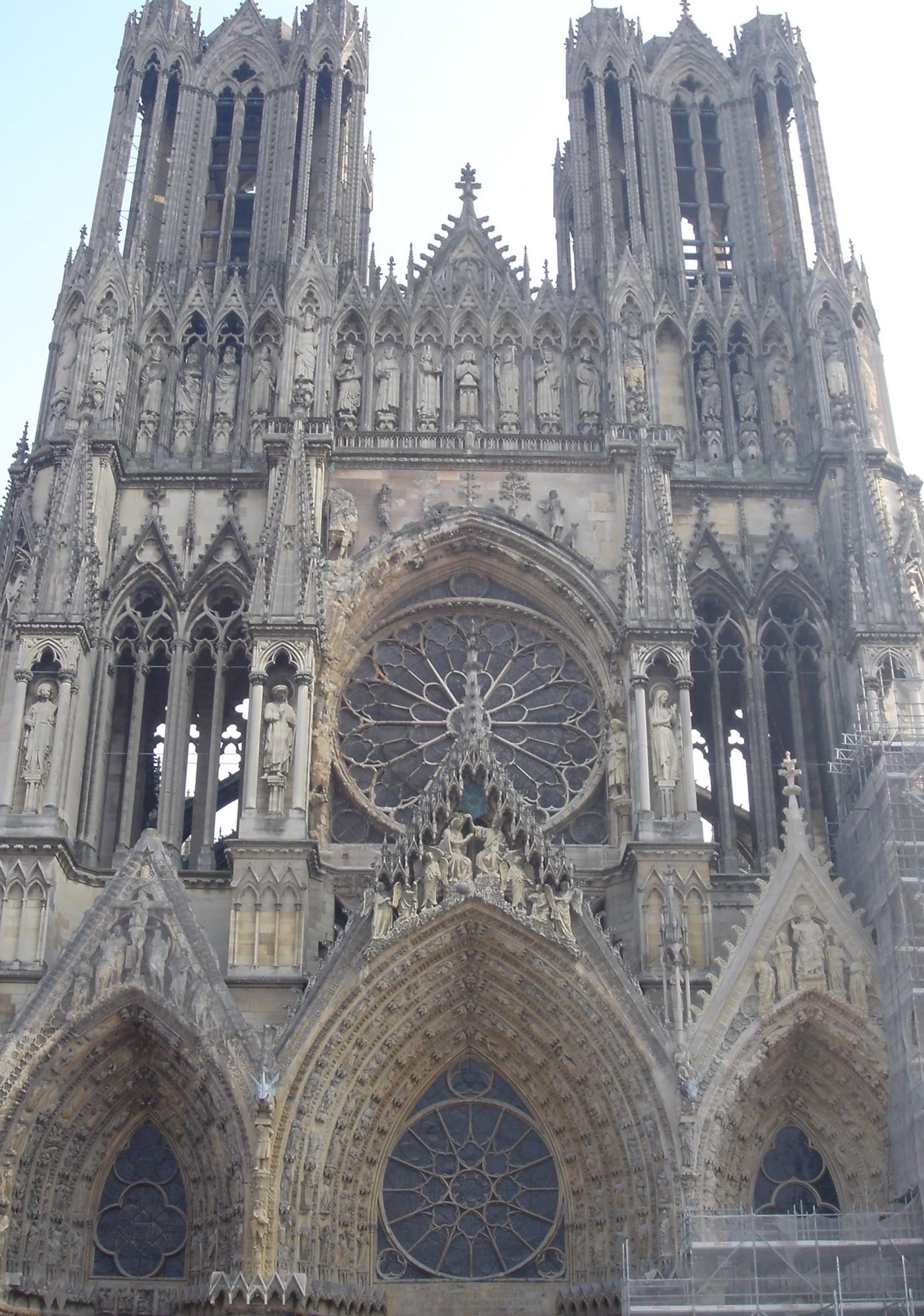
The first connection’s a little loose: “Gothic,” per the Online Etymology Dictionary, was “originally applied in scorn by Italian architects of the Renaissance” to northern European medieval architecture like, for example, Notre-Dame de Paris or the photo of the cathedral at Reims above, which I took in 2005 (this is why it's slightly crooked—the personal touch). We recognize the style by its pointed arches. Gothic architecture has nothing to do with Goths, but the name stuck.
How do we get from cathedrals to books? In the case of “gothic,” it’s pretty much just that people start using a word for medieval architecture to mean “medieval.” Here’s the Oxford English Dictionary on “gothic romance”:
The novel typically regarded as the first of this genre, The Castle of Otranto (1765) by Horace Walpole, is subtitled ‘a Gothic story’ (cf. 17651 at sense A.3a) in reference to its medieval setting; in this and similar early uses it is often difficult to distinguish between this sense and sense A.3a [medieval].
What exactly is a gothic romance? I’ll let this New York Public Library blog post do the defining:
While Walpole introduced what would later become the definitive tropes of the genre (creepy castles, cursed families, gloomy atmosphere), it was not until Ann Radcliffe’s A Sicilian Romance in 1790 that gothic romance began to develop as its own legitimate subgenre. Radcliffe kept many of the same tropes established by Walpole’s work, such as isolated settings with semi-supernatural phenomena; however, her novels featured female protagonists battling through terrifying ordeals while struggling to be with their true loves.
(A better version of this newsletter would discuss the book-cathedral relationship in Victor Hugo's Notre-Dame de Paris, but you know, sick kid and all that. I can offer you previous newsletters on that novel, though.)
I haven’t actually read any of the original gothic romances—if you have, please reply and tell me about them!—but here’s a small-r romance that I have read:
All of Us Murderers (m/m, both cis and gay, historical) by KJ Charles. One place I never want to be is a house party in a KJ Charles novel. Trapped in the foggy, rainy, hostile British countryside by even more hostile Brits who are trying to blackmail/terrify/murder/say the nastiest, snidest possible remark and ruin dinner, which is already inedible? And sometimes there are spiders? Get me outta there. But I love to read about it all day long, or all night long, as was the case here. And you know, sometimes your hot ex is at the neo-gothic manor house, and maybe you have a chance to explain things and redeem yourself while both of you are running for your lives, so it’s actually fine that you were trapped in Murder Manor with the most ghastly people alive. You were together! This is so fucking fun, and of course it’s really clever, and you know it’s in this newsletter for this passage where Zeb Wyckham reflects on his grandfather’s taste in fiction and architecture:
It was quite good as follies went, [Zeb] had to admit. The circle was tidily complete, rather than half-fallen as with the real thing, but the stones looked suitably weathered and lichen-covered, and the central altar-stone was just the right size and height for a nubile young lady in a white nightdress to be subjected to dark deeds with a sickle.
A scene of exactly that sort had been the dramatic climax of Walter Wyckham's The Stone Circle, a Gothic melodrama about a cult of murderous druids. Unless Zeb was thinking of Walter Wyckham's The Monastery, a Gothic melodrama about a cult of murderous monks. It was one of the two: his grandfather had been imaginatively drawn to hooded lunatics inflicting torture on young, beautiful, helpless people.
Walter Wyckham had been a highly popular novelist once, his perverse imagination striking a chord with a lot of readers, including Zeb in his misspent youth.
Gothic!! I could’ve quoted so many more paragraphs beyond that if only I hadn’t returned my copy to the library already. But immediately after this, Zeb thinks that Walter Wyckham probably always had sticky hands, which is such a gross, funny detail. There was a great mix of levity and creeping dread in this—and, of course, real romance. Library loan.
In things that are neither Romance nor romance, I read two very different graphic novels that both happen to have body swaps in them.
I picked up Crosswind, Volume One by Gail Simone and Cat Staggs on a whim after seeing it mentioned on Bluesky. It’s about a mafia hitman and a downtrodden housewife unexpectedly switching bodies—and loving it. I was interested to see a more trans-positive take on this trope. Both main characters were immediately sympathetic and are also total babes. The art makes it so clear, from the characters’ facial expressions and postures, who’s who. It’s also shockingly violent, or maybe that just struck me because I don’t read a lot of graphic novels, but even though I was reading through my fingers a few times, I did find it satisfying. I love a zany genre mashup, which we get here with one character being in a mafia story and the other character being like “what the hell is your life?” I had some questions about the worldbuilding and the villain that won’t be answered since this was published in 2018 and there’s no sequel, but they didn’t stop me from enjoying this. Library loan.
Flip! by Ngozi Ukazu is a young adult graphic novel that I picked up because I saw it on a few people's favorites-of-2025 lists and because I've enjoyed Ukazu's previous work. It's about Chi-Chi Ekeh, a Nigerian American high school senior at a private school in Texas who switches bodies with her rich-white-boy crush, Raymond “Flip” Henderson, after he publicly humiliates her. It’s not a romance, but is instead a really touching story about loving yourself. Flip’s life is less easy and perfect than Chi-Chi suspects; he’s envious of Chi-Chi’s family even though they’re poor, her parents are strict, and she has “like 100 chores,” because her parents know what classes she’s taking and care. Switching with Flip helps Chi-Chi realize that she’s cooler and worthier than she thinks. Lots of good conversations about race and privilege in this, plus very sweet friendships and some genuinely funny jokes. Library ebook.
That’s all for this time. Happy new year! I’ll be back in your inbox on January 18.
Word Suitcase is a free newsletter about words and books. If you enjoyed this one, subscribe by email or RSS for the next one. If you know somebody who'd like reading these, please pass it along!
Websites do cost money, so there is a paid subscription option and a tip jar for one-time donations. If you feel moved to support me, I’m very grateful. But please don’t feel obligated. I love having you as a reader either way.