
After the end
on romance novel epilogues

EPILOGUE, n. Like many highfalutin literary words, this one hasn’t gone through a lot of sound change over the years. English gets it from French, which got it from Latin, which got it from Greek, where it means, basically, “extra talking,” or a continuation of a literary work. Originally and specifically, an epilogue was a speech given after the end of a play. The word got shuffled around between literary forms to refer to other sorts of afterwords and final bits.
As a romance reader, I think of epilogues as a chapter after the last chapter, one where we see our main characters enjoying the Happily Ever After that they’ve spent the whole book fearing or fighting for, whether they were denying themselves or being denied by the world. It’s a kind of final relaxation of the shoulders: we’re okay now. It’s all good. Often these scenes take place after some time has elapsed, whether it’s weeks or years.
They’re quite common in genre romance. Or at least, I thought they were.
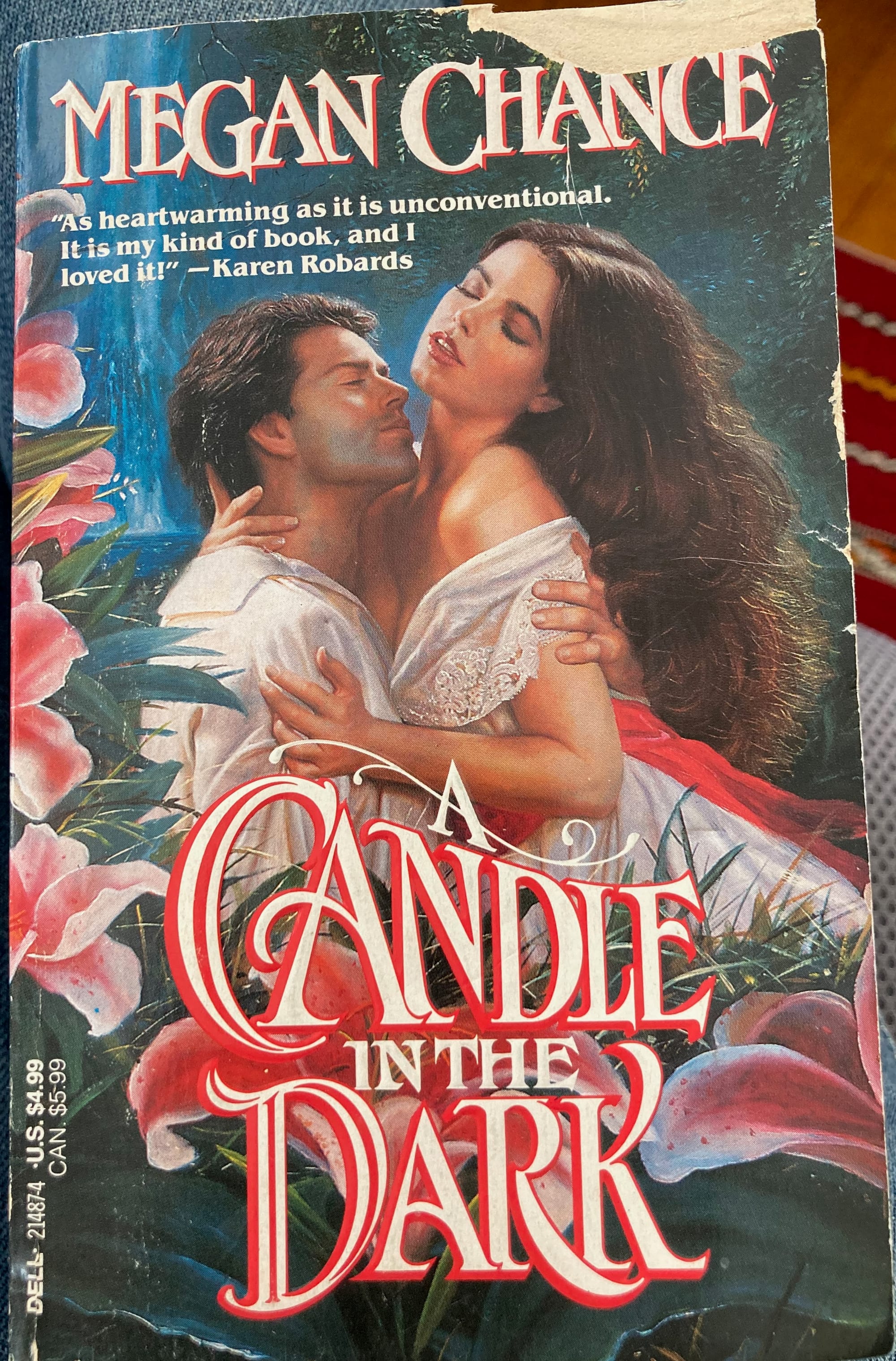
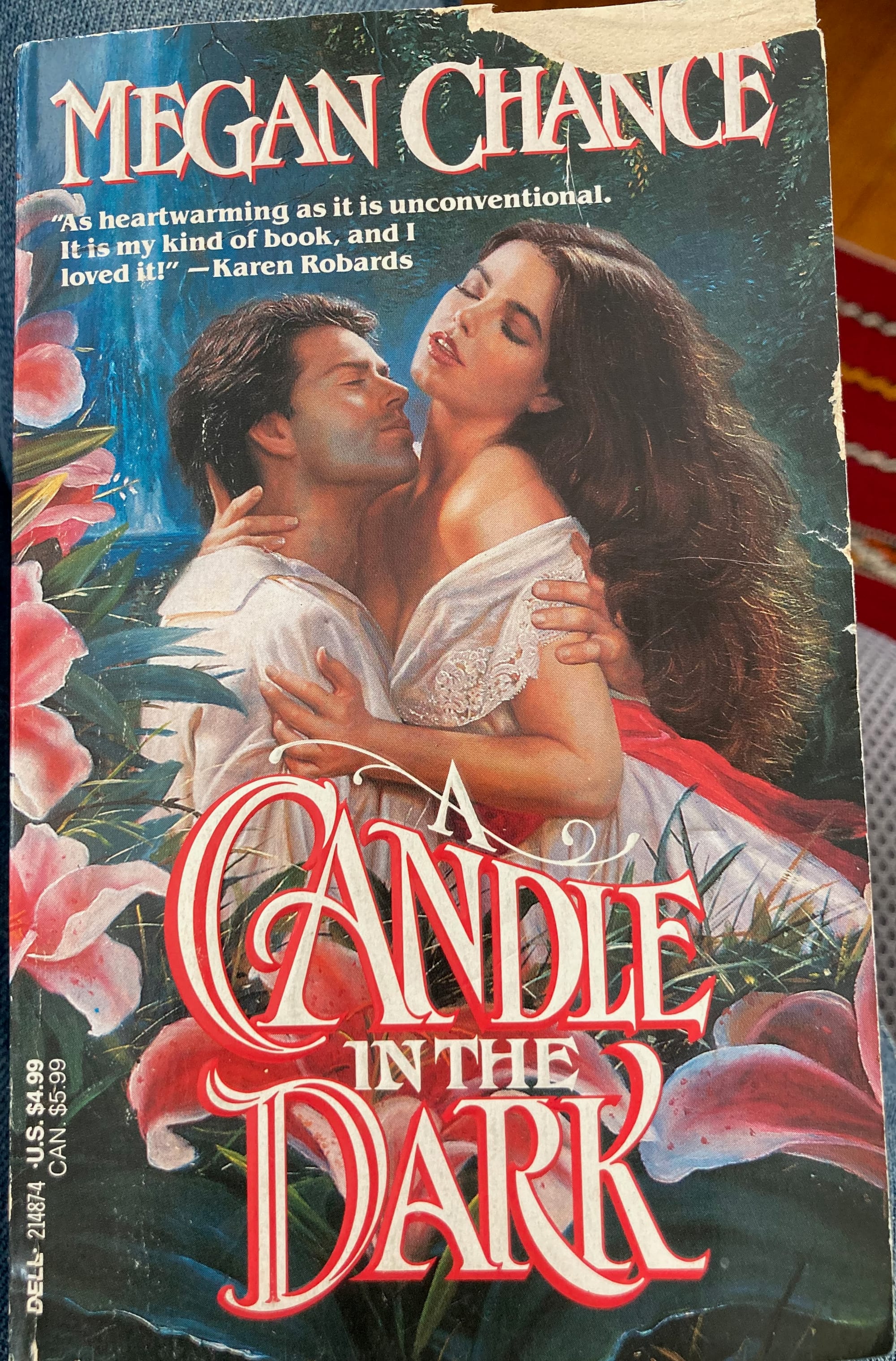
In my continuing adventures of buying old mass market paperback small-r romance, I read A Candle in the Dark (m/f, both cis and het, historical) by Megan Chance. This one’s from 1993 and it has a classic clinch cover with some real Choices in typography. I know “oil painter who does horny romance novel covers” is never coming back as a job, especially since big publishing houses would love to stop paying artists and instead simply extrude plagiarized slop. That’s just one small sign—among many, many large and fiery nightmare signs—of what a garbage world we live in.
The characters in this romance also live in a garbage world, and boy do they know it: it’s 1849 in New York City, and Ana is a sex worker who has just violently defended herself from an aggressive client, or, as the rest of the world will see it, “murdered a rich man.” She has to get out of New York, but she doesn’t want to get on the steam ship as a woman by herself, so she needs a hired fake husband, and the only man immediately available in the tavern is a half-conscious drunkard named Cain d’Alessandro. (I love romance novels.) He is, readers will soon discover, an extremely traumatized ex-doctor and a survivor of terrible childhood abuse, and his alcoholism is a form of “slow suicide.” In desperation, Ana promises to buy him liquor if he’ll take the ship to Panama with her and help her get to San Francisco, where she intends to start a new life.
Cain knew he was on the verge of saying yes, of leaving everything familiar to follow this woman. It was ridiculous—she was a murderess and a whore, and there was something about her cool manners that disturbed him.
A romance heroine written specifically to appeal to me! I get it, Cain: I’d say yes, too. The journey is fraught with peril, not least of which is what if somebody really saw you, and then decided you weren’t worthless, and cared whether you lived or died, and it turned out your cold dead heart wasn’t quite as cold and dead as you thought? This is the slowest of slow burns—she smiles at him for the first time on page two hundred and sixty-six—but its plot moves right along. There are fistfights and bandits and fevers and jungles to survive!
In case you are worried about the 1993 publication date and the setting in Panama, I went into this expecting to flinch at some exoticizing portrayals, and I did, but fewer times than I thought. There’s a major Panamanian character and he’s great and so is his whole family.
I wasn’t prepared to have so much difficulty with the period-accurate portrayal of medicine. Historical romance novels set in Europe or North America usually get around the leeches and bleeding stuff by having all good doctor characters be mysteriously modern eccentrics who have no truck with any of that, but this one doesn’t back away. Cain does have some doubts about the efficacy of his leeches by the end, but I was weirdly impressed by Megan Chance’s boldness in making him a regular mid-19th-century doctor—impressed as a writer, but grossed out as a human being.
One thing I’ve noticed in reading romances published in the ‘90s is that the conflict goes right up until the end, and then, boom, it’s over. A Candle in the Dark does have a satisfying ending, and I did believe Ana and Cain would stay together, but it feels markedly different from more recently published romances.
The endings of some of the other ‘90s publications I’ve read have had a similar quality: we will not be lingering over scenes of happiness, post-resolution. We are resolving that conflict and then we are done. Flip the page to the order form for more mass market paperbacks. Heroine finally says yes to the hero, we’re out. You’ve seen them weather all this conflict, so you know they’re gonna be fine now, what do you need more for? Meanwhile, more recently published romances often resolve the characters’ problems one or two whole chapters before the book ends. The characters get to enjoy their Happily Ever After on the page. It’s a big, noticeable change.
Newer books often have lower stakes or less conflict overall. The rope bridge that characters have to cross isn’t so long or so frayed or missing so many slats. The gorge itself is narrower, the river not so far below. The wind isn’t even howling. And when they do finally make it across, we want them to lie down and catch their breath for longer. Set out a picnic, maybe. Take a nap in the sunshine.
It’s easy to speculate about why—there’s that garbage world seeping through again, sending push notifications to our phones. For myself, while I love a nice high rope bridge, when I read these romances from the ‘90s, I often miss that last, relieved exhalation that I’m accustomed to in more recent publications. I want to read the part where everything’s okay. I want to bask in it for a couple of pages at least. Why else would I be so devoted to this genre that promises that it's all gonna work out?
So it’s fascinating to discover that romance novels used to spend a little less time detailing exactly what Happily Ever After looks like. I am, of course, aware that this is the whole point of the fairytale’s closing phrase: “And they lived happily ever after” means “we don’t gotta get into all that, the interesting part’s over.”
Maybe these days a lot of us feel like we’re about to cross that rope bridge, or swaying precariously in the middle while everything creaks and groans, and it’s hard to imagine we’ll ever reach the other side. I’d like somebody to describe solid ground to me. Not just to promise me that we’ll get there someday, but to draw my attention to the earth, the grass.
That's all for this time. I'll be back in your inbox on March 29.
Word Suitcase is a free newsletter about words and books. If you enjoyed this one, subscribe by email or RSS for the next one. If you know somebody who'd like reading these, please pass it along!
Websites do cost money, so there is a paid subscription option and a tip jar for one-time donations. If you feel moved to support me, I’m very grateful. But please don’t feel obligated. I love having you as a reader either way.